Amsterdam’s streets are full of details that are easy to walk straight past. Among them are hundreds of small interventions by Frank de Ruwe, better known as Streetart Frankey (sometimes spelled Frankie or Franky). Since 1998, he has turned bollards, drainpipes, street signs, bridges and other everyday objects into something unexpected, usually with a good dose of humour.
Part of the fun is that his work encourages you to take a closer look at the city. Once you start spotting Frankeys, you find yourself paying more attention to things you might normally ignore: the top of a street sign, a drainpipe on a building or something unusual attached to a bridge.
In this guide, you’ll find out who Frankey is, why he has been compared with Banksy, some of the works to look out for, and how our live map can help you find them around Amsterdam.
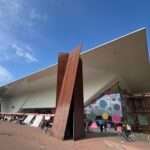
Header photo: Streetart Frankey’s Pride Baloo on Museumplein, by Amsterdam Experiences
Streetart Frankey is a Dutch artist based in Amsterdam, known for small and often subtle interventions in public space. A bollard might become a rocket, a drainpipe a chimney, or a street sign part of a joke that only becomes obvious when you stop and look properly.
An important part of his approach is that the work should not damage the city. His pieces are attached using magnets, cable ties, tape, wire and other removable methods. When installing them, Frankey is often recognisable by his red beanie and orange work jacket, looking not unlike one of Amsterdam’s municipal workers.


Photos: Amsterdam Experiences
Belgian newspaper HLN once described Frankey as Amsterdam’s own Banksy, and in the Netherlands he is often simply called the Dutch Banksy (de Nederlandse Banksy). The comparison has followed him ever since. Frankey himself has spoken about being inspired by Banksy’s book Wall and Piece, and there is an obvious similarity in the way both artists use the street itself as part of their work.
But the comparison only goes so far. Banksy’s identity remains secret and much of his work carries a political or social message. Frankey works openly and takes a much more playful approach, using familiar objects and places to introduce something unexpected into the city.
He describes this approach as positive disruption, also the title of his 2024 book, Frankey: Positive Disruption. The idea is simple: make a small change to an everyday place that causes people to stop, look twice and perhaps smile.
Banksy is not the only artist he is compared with. Reviewing the 2026 documentary Streetart Frankey, De DocUpdate placed him at the crossroads of Maurizio Cattelan, Wim T. Schippers and Banksy. The Cattelan comparison makes sense: the Italian artist behind Comedian, the banana taped to a gallery wall, also uses humour and everyday objects to make people look twice.
The difference is where you find the work. Cattelan’s pieces end up in museums and at auction, while Frankey’s are on a bollard, a drainpipe or a street sign around the corner, free for anyone who looks up.
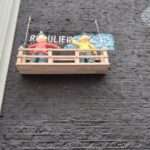
Once you start looking for Frankey’s work, walking around Amsterdam can become something of a treasure hunt. Some pieces have become well known in their own right, including his bronze tribute to former mayor Eberhard van der Laan, André Hazes in Lego on Dam Square, B.B. King on the side of the Stopera, and Tante Leen on the Middenweg. Look out too for Buurman & Buurman, the hapless DIY duo from the Czech cartoon known abroad as Pat & Mat, who have been busy on a job in the city centre since 2020 (see it on the map).
Others are tiny, tucked into unexpected places or disappear not long after they arrive. That temporary nature is part of Frankey’s street art. You can pass the same corner dozens of times and suddenly find something new there.


Photos: Amsterdam Experiences
Frankey does not publish a map of his own work, and there is something to be said for simply stumbling across one when you least expect it. But with hundreds of works created over the years, we thought it would also be useful to have somewhere to find them.
Map data © OpenStreetMap contributors. Photo in card: Ceescamel, CC BY-SA 4.0, via Wikimedia Commons.
Our interactive Streetart Frankey map includes more than 490 of his artworks across Amsterdam, including works that are still there and others that have disappeared.
Street art changes quickly, and this is where the map becomes a collaborative project. If you pass one of the artworks, you can tell us whether it is still there or has disappeared. Once enough people report a work missing, its pin turns brown.
Some works are initially mapped only to a street because we don’t yet know their exact position. If you know precisely where one is, you can help us place it by sharing the location, selecting the spot on the map or entering the address. We check submissions before updating the pin.
The more people use it, the more accurate the map becomes.
Frankey is only one part of Amsterdam’s street art story. Take an Amsterdam Street Art tour with one of our local guides, which also includes murals, street art, and some of the city’s less obvious corners along the way. If Frankey particularly interests you, let us know, and we can include some of his works on the route.
Amsterdam may be Frankey’s home and the place most closely associated with his street art, but his work is not confined to the city. He regularly creates work elsewhere in the Netherlands, including Zandvoort, where several of his much larger creations have appeared around the beach and town.

HubbaBubbaBuilding, Zandvoort – Photo: Amsterdam Experiences
His work has travelled much further too, with projects and interventions appearing internationally. One of his best-known early international exploits involved placing a small figure on Trump Tower in New York, and his work has since been exhibited and installed in locations around the world.
So even if our map concentrates on Amsterdam, keep an eye out elsewhere. A Frankey can turn up where you least expect one.
Streetart Frankey is the working name of Frank de Ruwe, a Dutch artist based in Amsterdam. Since 1998, he has been placing small, playful pieces on street signs, bollards, walls and bridges, designed to make passers-by stop, look twice and smile.
Belgian newspaper HLN called him Amsterdam’s own Banksy, and in the Netherlands he is often called the Dutch Banksy. Frankey has said that Banksy’s book Wall and Piece inspired him. Like Banksy, his work appears unannounced in public spaces, although Frankey works openly and his approach is generally more playful than political.
Yes. A review of the 2026 documentary Streetart Frankey placed him between Maurizio Cattelan, Wim T. Schippers and Banksy. Like Cattelan, known for the banana taped to a gallery wall, Frankey plays with humour and everyday objects, but his work is out on Amsterdam’s streets for anyone to find.
No. He fixes his work with magnets, cable ties, tape or wire, so his pieces can be removed without leaving a mark.
Yes. Our Streetart Frankey Amsterdam map shows more than 490 of his artworks, with photographs, neighbourhoods, and information about whether each piece is still there.
He shares a new piece every Saturday on Instagram and in Het Parool. We check for new work every week and add it to the map.
Brown pins are artworks that have been reported missing. Frankey’s pieces are small and removable, so many are taken or removed over time. If you pass one, tap Still there or Gone on its card to help us keep the map up to date.
Open the artwork’s card on the map and tap Know the exact spot? Help us place it. You can share your phone’s location while standing beside it, tap the exact spot on the map, or enter an address. We check every tip before moving the pin.
Yes. Ask us about a private street art walking tour. We can build the route around the art itself, including plenty of Frankey’s pieces along the way.
Yes. His official website is frankey.com, where you can find an archive of his work and contact information. For his newest pieces, follow @streetartfrankey on Instagram.
No. Although Amsterdam is most closely associated with his street art, Frankey also creates work elsewhere in the Netherlands, including Zandvoort. His work has travelled internationally too, with projects and interventions appearing in cities including New York.