
Enter your visit date and see exactly when Anne Frank House tickets go on sale for that day, converted to your own timezone. We check annefrank.org live, so you also see whether anything is available right now.
Anne Frank House tickets go on sale one week at a time, always on the Tuesday about six weeks before the visit week, and most time slots sell out within minutes. Enter your date below and Bespoke Amsterdam Experiences checks annefrank.org live: you get the exact release moment converted to your own timezone, and whether anything is on sale for that week right now. It covers 2026 and 2027, including the second, last minute Tuesday release.
Tickets on sale this week: none. Every day from 19 October to 25 October 2026 is sold out on the museum’s own ticket system. Checked 19 October 2026 at 21:15 Amsterdam time.
Tickets are on sale up to Sunday 29 November 2026, which is as far ahead as the museum has released. Of those 41 days, 26 still have tickets and 15 are sold out. The earliest date you can still book is Monday 2 November 2026. Sold out after that: Friday 6 November 2026, Saturday 7 November 2026. Checked 19 October 2026 at 21:23 Amsterdam time.
This check is free. No signup, no email address and no charge, unlike the paid alert services. We are not the museum and we do not sell tickets: Anne Frank House tickets are only ever sold on the official site, annefrank.org.
Checked 19 October 2026 by Bespoke Amsterdam Experiences. Release dates are calculated from the museum schedule rather than copied from a list, so they stay correct for any date you enter, and availability is checked against annefrank.org the moment you ask.
Bespoke Amsterdam Experiences is rated 4.9 out of 5 from more than 3,000 guest reviews on Google, Tripadvisor, Airbnb and GetYourGuide, verified by Trustindex.
Sold out, fully booked, or no tickets showing at all? We can still get you inside. On our private Anne Frank walking tour in Amsterdam your official Anne Frank House tickets are included when you book at least 13 days ahead, or step into the Secret Annex in virtual reality on the Anne Frank Last Walk small-group VR tour.
The Anne Frank House sells tickets exclusively through its official website, annefrank.org. There are no legitimate third-party resellers, you can’t buy tickets from the museum on the day, and the I Amsterdam City Card is not valid. There are no waiting lists, tickets are non-refundable and non-transferable.
2026 ticket price: €16.50 for adults, €7 for ages 10 to 17, and €1 for children under 10.
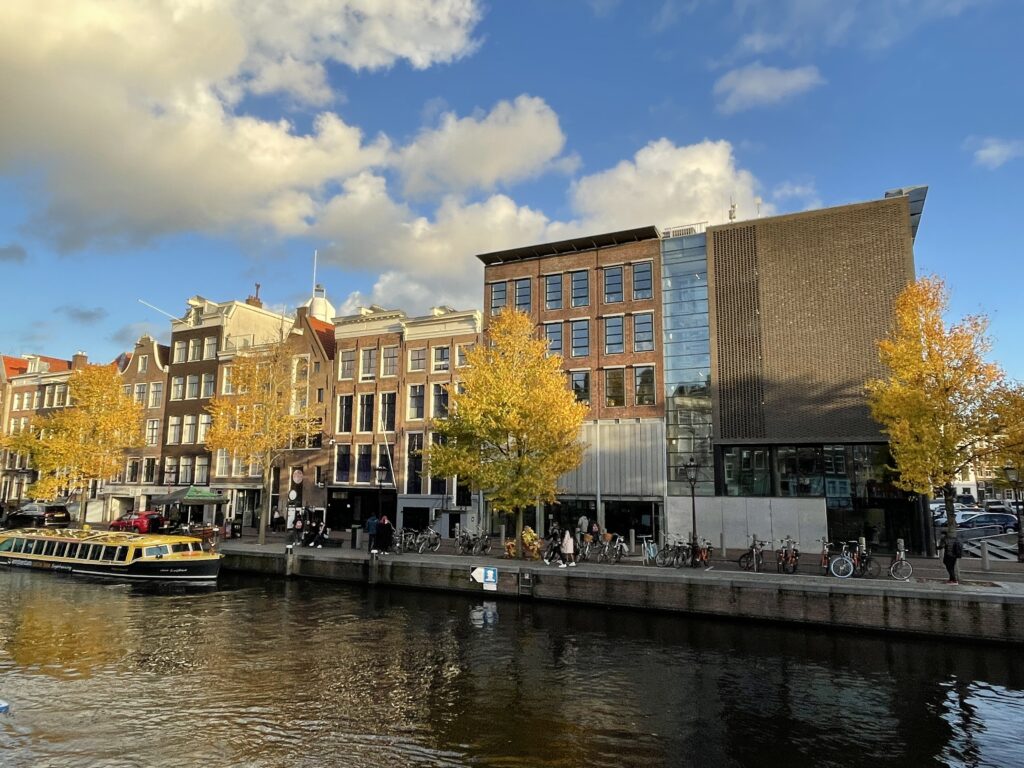
The Tuesday Rule is the only way to get the tickets you require:
So on Tuesday 7th July, tickets go on sale for the week Monday 17th August to Sunday 23rd August.
The Anne Frank House is a tiny 17th-century canal house with a narrow staircase to the Secret Annex. The museum hosts around 1.2 million visitors a year, but demand from every continent is much higher.
In spring and summer (April to September) and on weekends, popular slots (around late morning and early afternoon) can be sold out in two to three minutes after release. Off-season and evening slots stay available for longer, although they also sell out after a few days.
The museum sells two things in the same Tuesday release. One is a plain museum visit. The other is a museum visit with a thirty minute introductory programme beforehand, in English, which puts Anne Frank’s story in the context of the Second World War. They are separate products with separate stock, so if the regular slots for your date have gone, look at the introductory programme tickets before giving up on that day.
For the full walkthrough, including what the tickets cost, the exact release schedule and every option if your date is already sold out, read our guide on prices, cards, the stairs and your sold-out options.
Anne Frank House tickets are sold in one place only, the museum’s own website, at €16.50 for an adult including the €1.00 booking fee. Anything offered on a resale platform is being sold against the museum’s own rules, and buying it puts your visit at risk rather than securing it.
Three lines from the museum’s own visiting conditions are worth reading before you pay anyone else:
Tickets also cannot be exchanged or refunded, so a resale listing is a payment with nothing standing behind it. Resale prices are capped by nobody, which is how people end up paying many times the €16.50 the museum charges for a ticket that can be refused at the entrance with no way to get the money back.
If your date is sold out, the two honest options are the next release, which the calculator above dates for you, or a guided alternative. Both are further down this page.
There is one price list and one seller. These are the museum’s own figures, each including the €1.00 booking fee, checked on 6 October 2026.
| Who | Price |
|---|---|
| Adults, 18 and over | €16.50 |
| Ages 10 to 17 | €7.00 |
| Ages 0 to 9 | €1.00 |
The price is the same whichever Tuesday you buy on, and the same for the last minute release. There is no premium slot, no skip the line upgrade and no family ticket. Nothing is sold at the door: in the museum’s words, “Tickets are not sold at the door, only online.”
Prices for 2027 have not been published yet. When the museum sets them we update this table and the date above.
No, and it is worth understanding why before you spend money on one.
Every ticket to the Anne Frank House is a timed-entry ticket. You book a specific 15 minute arrival window, you turn up in that window, and you go in. There is no faster queue to buy your way into, because there is no slow queue to skip. The only line is the short one of people holding the same entry time as you.
So when a reseller advertises a skip-the-line Anne Frank House ticket, one of two things is true. Either they are selling you an ordinary timed ticket at a markup, or they are selling you something the museum will not accept at the door. The museum states plainly that tickets are sold on annefrank.org and nowhere else, and it warns visitors about sites with similar looking addresses.
A guided tour is a different matter, and an honest one. It does not skip a queue, it adds a guide and the story of the neighbourhood. What it cannot do is create a museum ticket that does not exist.
If you hold a Museumkaart, an ICOM card, a Stadspas or a VriendenLoterij VIP-kaart, entry to the Anne Frank House costs €1. That is the online booking fee, not an admission price. A European Youth Card brings it down to €7.
Here is the part people get wrong. None of these cards lets you walk in, and none of them gets you a slot outside the normal release. You still book a timed ticket on annefrank.org, in the same Tuesday release, competing with everybody else. The card changes the price, not the queue.
The I amsterdam City Card is different again: it does not include the Anne Frank House at all. If a card, tour or package claims to include entry, treat that as a warning rather than a bargain.
Full 2026 prices as listed by the museum:
The museum is open every day of the week, from 9:00 to 22:00 Amsterdam time. There is no weekly closing day. The late evening slots are usually the last to be taken, so if the daytime is gone for your date it is worth looking at the end of the evening before giving up on the day.
The standard hours, and the dates in the year that run differently:
Opening hours only decide the shape of your day once you hold a ticket. Entry is by timed slot and nothing is sold at the door, so you cannot turn up inside opening hours and hope for a place. The dates the museum closes altogether, for Yom Kippur and for maintenance, are listed in the calculator above. Hours as published by the museum on annefrank.org.
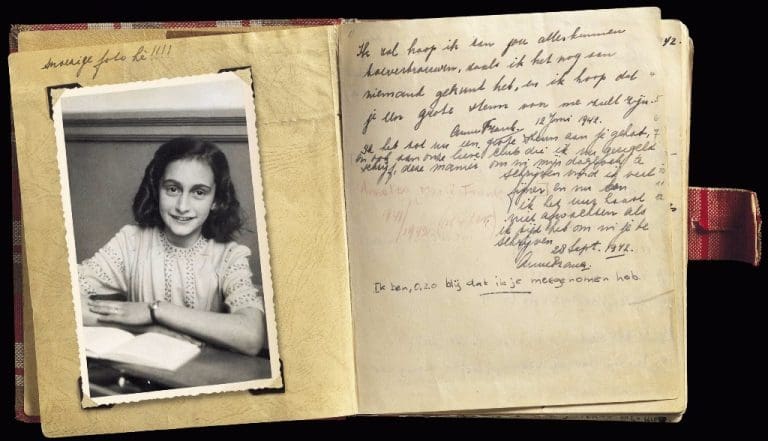
If there is nothing available once you reach the booking page, don’t worry. Try refreshing the page.
Come back between 10.30 and 11 am. Tickets often become available as the queue clears. Do not give up at the first empty page. Often, people have tickets in their shopping cart and then don’t buy them, so they are returned to availability.
Ensure that you are on the English, not the Dutch page. This should have /en after the website. Or you can select the language in the top right corner. This is the correct link to the English language ticket site. https://www.annefrank.org/en/museum/tickets/choose-your-ticket/
There are two release moments, not one, and most guides only mention the first.
The main release is every Tuesday at 10:00 Amsterdam time, for visits six weeks later. The second is a last-minute batch, also on a Tuesday at 10:00, covering the week that begins the following Monday. If you are visiting in the week of Monday 12 October, the last-minute release lands on Tuesday 6 October.
Nothing is released on the day itself and nothing is sold at the door. Sold-out days do occasionally reopen for a few minutes when an unpaid booking times out, so the half hour after either release is the moment worth refreshing. The live check at the top of this page tells you what the museum’s system is showing for your week right now.

There is no waiting list. Once a date sells out, no further tickets are released. These are the two reliable alternatives.
This is your best chance at still getting inside the house. When you book at least 7 weeks before your visit, we have a strong track record of securing Anne Frank House tickets as part of the tour (subject to the house being open on that date). If your required visit date is less than 7 weeks away, we have a high success rate in securing tickets, up to 13 days before the visit.
You also get a highly-rated, private guided walk through Amsterdam’s Jewish Quarter and the story behind Anne Frank’s diary.
Book the private Anne Frank and Jewish History walking tour →
A small-group walking tour following part of Anne Frank’s final route through Amsterdam. Ending with an immersive Virtual Reality visit to the Secret Annex, as it was in 1942, including furniture. Many guests say that the furnished VR rooms give more insight than the empty rooms inside the actual house.
This tour is independent of the museum. Available daily. Bookable even at short notice.

If the stairs are the obstacle rather than the ticket, we can bring the Secret Annex to you. With Virtual Reality you walk through the hiding place room by room, at your own pace, with nothing to climb.
We arrange this privately, shaped around what works for you:

Both work for wheelchair users and for anyone who finds stairs difficult, and both can be arranged for a single visitor or a family.
One thing to be clear about: these step-free formats are private arrangements only. Our shared small group tour finishes with the Virtual Reality section up one flight of stairs, and we cannot change that on a departure other people are booked on. So if stairs are a problem, book privately rather than joining the small group and hoping.
Full details, including how it works at your hotel or on a river cruise ship, are on our step-free Anne Frank experience, or tell us what you need and we will put something together.
The museum route climbs three steep staircases and there is no lift to the Secret Annex. For exactly what that climb involves, and what the rooms feel like once you are up there, read what a visit to the Anne Frank House is really like.
They are the same place. The museum’s own name is the Anne Frank House, Anne Frank Huis in Dutch, at Prinsengracht 263-267. Plenty of people search for Anne Frank Museum tickets instead, and the calculator on this page works for either, because there is only one building and one ticket system.
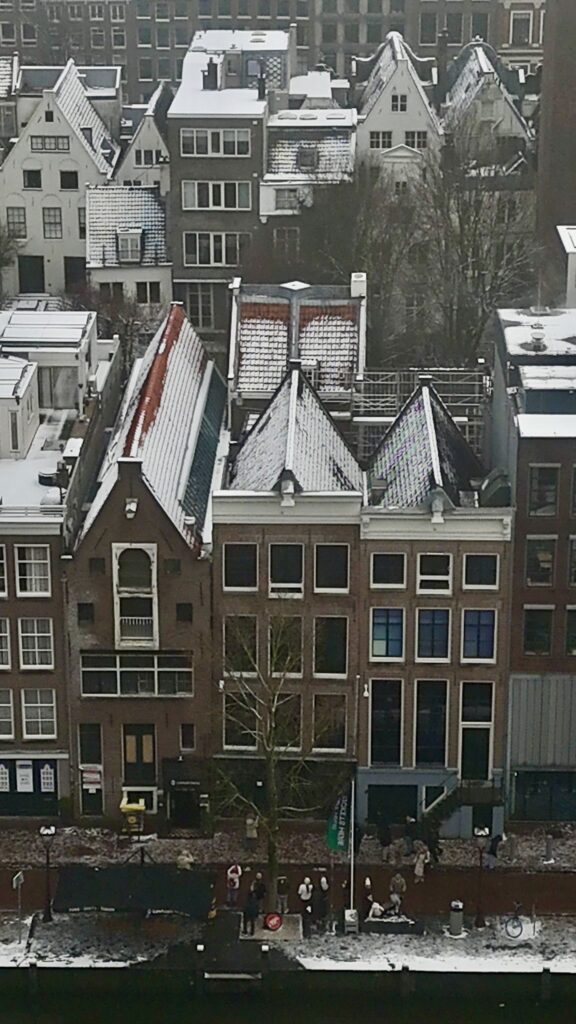

For what you actually walk through once you are inside, the empty rooms and why Otto Frank wanted them left that way, read what a visit to the Anne Frank House is really like.
The entrance is at Westermarkt 20, around the corner from the house itself at Prinsengracht 263-267. The complication is that the tram stop called Westermarkt, the obvious way to arrive, currently has no trams at all.
GVB is rebuilding the track along the Rozengracht and the Raadhuisstraat as part of the Oranje Loper works. For two years now, trams 13 and 17 have not run between the Dam and the Rozengracht junction with Marnixstraat, and nothing calls at Westermarkt. Tram 17 has been on diversion since 15 February 2025, and GVB’s published plan runs that diversion until 27 February 2027, so trams should be back at the Westermarkt right at the end of February 2027. We follow GVB on this, because GVB runs the trams. If you see February 2028 quoted elsewhere, including on the museum’s own practical information page, that refers to the wider Oranje Loper programme rather than the return of the tram to this stop. Either way, for any visit before March 2027, plan on walking.
There is no car park at the museum and nowhere to stop outside it. The entrance sits on a square in the canal ring, where parking is paid and scarce, and the two roads that would normally bring you to the door, the Raadhuisstraat and the Rozengracht, are a building site. If you are driving to Amsterdam, leave the car at a P+R on the edge of the city and come in by metro or tram. If you are already staying in the centre, walk: it will be quicker than finding a space.
Tram information as published by GVB and checked on 6 October 2026. Dates on works like these can move, so check your route on the day you travel.
The Tuesday 10:00 release six weeks ahead has run throughout 2025 and 2026 and there is no sign of it changing. The calculator above already handles 2027, so you can check any date next year today.
The first full week of 2027, Monday 4 to Sunday 10 January, goes on sale on Tuesday 24 November 2026 at 10:00 Amsterdam time, and every week after that follows one Tuesday at a time. If you are planning a January or February trip, that is the morning to have the booking page open.
What the museum has not published yet is 2027 pricing or its 2027 closing dates. One date you can already pencil in: the museum closes for Yom Kippur every year, and in 2027 Yom Kippur falls on Monday 11 October. We will confirm it here as soon as the museum publishes its own 2027 calendar. We check the official ticket pages every week and update this page when they land, so the figures here are never more than a few days old.
Ticket rules, prices and closing dates on this page were last checked against annefrank.org on 19 October 2026. We check every week.
Tickets are one of several things worth timing before you fly. Our trip planning tools for the Netherlands cover the rest: when the flowers are out, what is on while you are here, and which museums are worth the trip.
Everything you need to know about buying Anne Frank House tickets online.
Tickets are released every Tuesday at 10 am Amsterdam time (CEST in summer, CET in winter) for visit dates six weeks later. Use this calculator to find the exact Tuesday and time for your visit date, converted to your local timezone.
We check the museum’s own ticket system and publish the answer higher up this page, together with the date and time of the check, so you can see which dates still have tickets without clicking through the booking calendar day by day. Because the museum puts one visit week on sale at a time, every Tuesday at 10:00 Amsterdam time for visits six weeks later, the dates most likely to still have tickets are the ones released most recently.
The museum does not sell tickets earlier than six weeks before the visit date. If your visit is more than six weeks away, the calculator will show you the exact Tuesday and time to be online, and you can add it to your calendar so it will automatically remind you.
Only for dates inside the six-week release window. The museum puts one visit week on sale at a time, every Tuesday at 10:00 Amsterdam time, for visits six weeks later, so a date in 2027 becomes bookable on the Tuesday six weeks before it and not a day earlier. Enter your 2027 date in the calculator above and it works out that exact Tuesday for you. The museum has not published its 2027 prices or its 2027 closing dates yet.
If the tickets sell out at 10 am, it is worth refreshing the page around 10:30 am, as small numbers of tickets reappear as the queue clears. There is no official waiting list.
There are two reliable options.
First, book a private Anne Frank and Jewish History walking tour with Amsterdam Experiences, where we help you to secure official tickets via the official channel as part of the tour. When booked 7 or more weeks ahead of the time of visit, we have a high success rate of securing tickets.
Second, join Anne Frank walking tour: the Last Walk and Secret Annex VR: a guided walk through Anne Frank’s Amsterdam ending with an immersive Virtual Reality visit to the fully furnished Secret Annex. Independent of the museum and available daily. Last-minute slots are often available.
No. The museum only sells tickets via annefrank.org. There are no walk-in tickets, no on-site sales, and no ticket resellers. Any website other than annefrank.org selling Anne Frank House tickets is unofficial.
Tickets cost €16.50 for adults, €7 for visitors aged 10 to 17, and €1 for children under 10. All prices include a €1 booking fee. A 30-minute introductory programme is available for €7 extra per ticket. The museum has not published its 2027 prices yet, so any site quoting them is guessing. We check annefrank.org every week and this page will carry the 2027 figures as soon as they appear.
Museumkaart holders pay €1, which is the online booking fee rather than an admission price. ICOM, Stadspas and VriendenLoterij VIP holders pay the same. The I Amsterdam City Card cannot be used for entry at all, so those tickets have to be bought separately through annefrank.org. Whichever card you hold, you still have to book a timed ticket in the normal Tuesday release like everyone else, so the card changes the price, not the queue.
No. The Anne Frank House sells tickets through its own website only, and its visiting conditions state that resale is not permitted without the museum’s prior permission. A visitor can be denied access if the ticket was not acquired directly from the museum or an organisation authorised for this purpose, and tickets are never exchanged or refunded. Resale prices are capped by nobody, so you risk paying many times the €16.50 face value for something that may be turned away at the door. Use the calculator above to catch the next official release instead.
The museum is open daily from 9:00 to 22:00. A handful of dates have shorter hours or a closure, and the dated list higher up this page is checked against annefrank.org every week.
Yes, it is one place at Prinsengracht 263-267. One ticket covers both the canal house with the Secret Annex behind it and the museum building next to it, where the exhibitions and Anne’s original diary are. The route takes you through the house first and the museum afterwards.