Just steps away from the greenery of the Vondelpark stands Vondelkerk, one of Amsterdam’s most distinctive and architecturally historic buildings. It is easy to overlook at first, but once you notice it, the church has a way of holding your attention. Sadly, in the early hours of 1st January 2026, Vondelkerk was engulfed in a fire that started in the central spire.

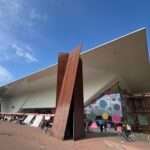
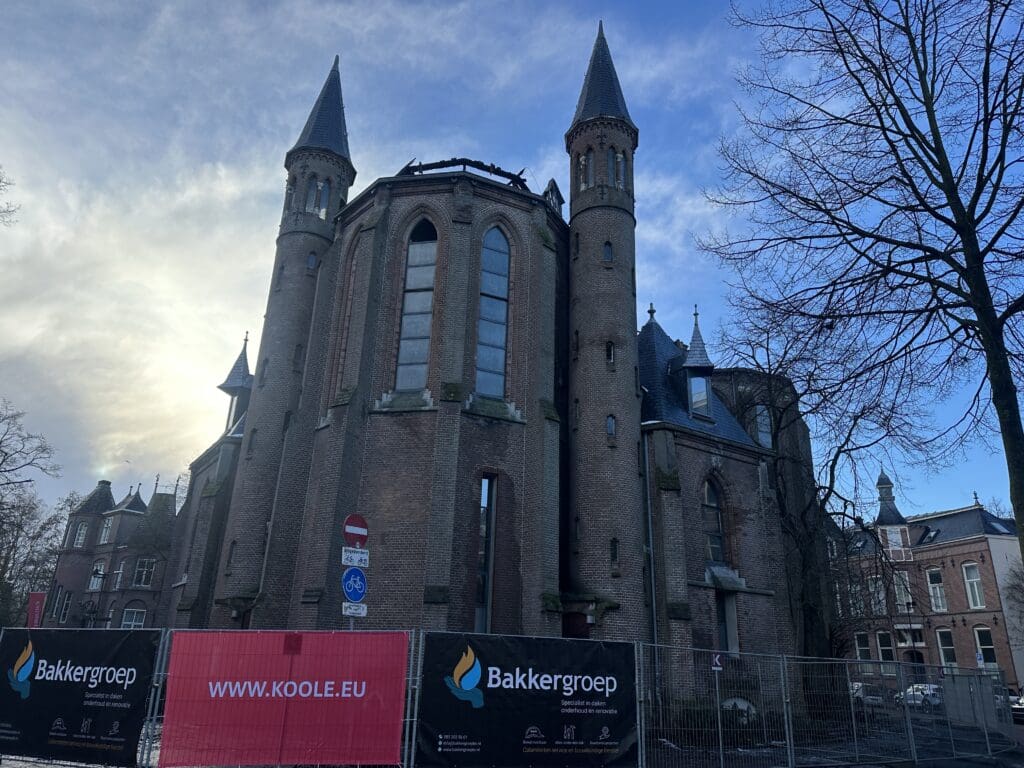
Vondelkerk was designed by Pierre Cuypers and completed in 1880. Cuypers played a defining role in shaping the visual identity of the city. As with his other Amsterdam creations, the Rijksmuseum and Central Station, this church reflected his mastery of neo-Gothic architecture. The same eye for detail is all over the Rijksmuseum building and its gardens, and most of it can be enjoyed without a ticket. Built in red brick with pointed arches, slender spires and intricate detailing, the structure was both solid and expressive, grounded yet aspirational.
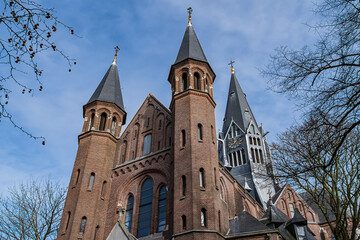
From the outside, the church presented a strong, almost rhythmic façade. Vertical lines guided the eye upwards towards the central spire, while decorative stonework added texture and depth. It was unmistakably neo-Gothic, but never overwhelming.
Inside, light filtered softly through stained glass windows, casting muted colours around the knave. The interior had a calm sense of intimacy that contrasted with the bold, harsh exterior. Designed as a place for reflection, that intention still lingered, despite the building taking on new functions over time.
Vondelkerk was originally built to serve the growing Catholic community of late nineteenth century Amsterdam, as the city expanded beyond its historic centre. Like many churches, its role evolved with the city itself, and it was finally deconsecrated in 1977.
In recent decades, the building has hosted cultural events, talks and gatherings, becoming a flexible space rather than a purely religious one. This ability to adapt helped keep Vondelkerk relevant and alive within the neighbourhood.
As 2025 came to a close and the new year of 2026 began, a fire broke out at the tip of the spire. The cause, has yet to be confirmed, however, videos show fireworks going off all around the church moments before the fire took hold.

Video via TikTok user @al_pal8
The fire has destroyed the spire and the roof of the Vondelkerk, leaving visible scars on a building many people consider a permanent fixture of the area. At the time of this article, it is expected that this historic building will be restored, but there is no indication as to when or how much it will cost to do so. As with the Notre Dame fire in Paris, this incident is a stark reminder that even the most familiar landmarks are vulnerable.
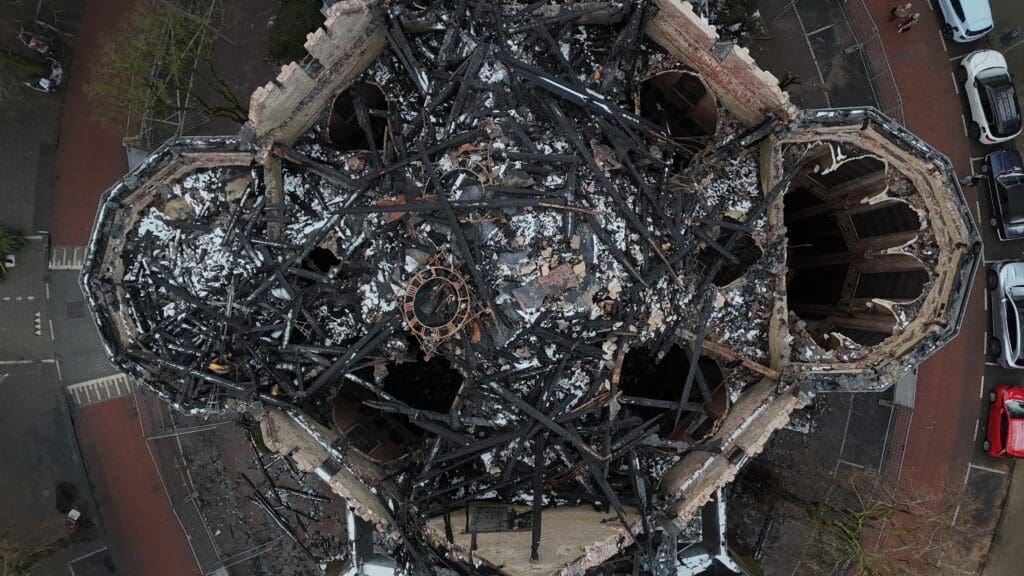
The video footage of the aftermath, along with photographs in this article, clearly show the impact of the fire. The images capture both the damage and the resilience of the structure. Despite what happened, the character of the church remains unmistakable, with the haunting image of the remnants of the spire clock reminding us of how quickly time passes.
Vondelkerk is more than an architectural monument. It is a living part of the city’s history, shaped by time, use, and now by tragedy. Moments like this become part of a building’s story, adding another layer to its meaning.
Should a full restoration be possible, Vondelkerk will continue to stand beside the park, changed but enduring. Its presence reminding us that history is not static. It is something that survives, adapts, and carries its marks into the future. Perhaps now is a good time to reflect on how we should protect buildings of the past, for history in the future.
A crowd-funder is in place to help raise the money required to restore the building to how it was before the fire. It is being run by Friends of Stadsherstel – Vondelkerk. Any donations will be greatly appreciated. You can also buy a build-it-yourself model of the church via this link, with all of the proceeds going to the restoration fund.
Amsterdam’s architectural heritage goes far deeper than its canal houses. To explore the city’s built history with an expert guide, our private architecture tour of Amsterdam traces the layers of the city from the golden age to the bold visions of the 19th and 20th centuries.
UPDATE: May 2026
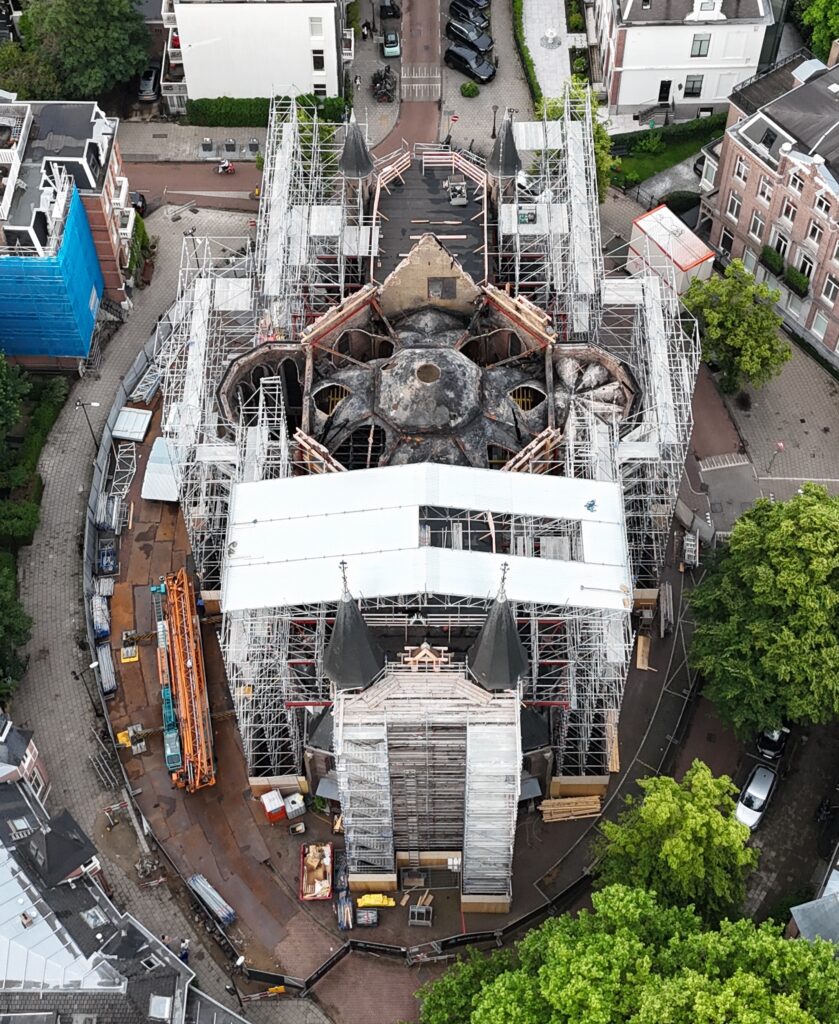
After 5 months of work to clear all of the debris, the Vodelkerk is now surrounded by scaffolding to stabilise the building. The crowdfunding has already raised over €366,944, from more than 5,000 individual donations. There is still a long way to go, but things are looking better for the church, and it is hoped restoration work will start in September.
UPDATE: Autumn 2026
The Vondelkerk is now completely wrapped in scaffolding and sits beneath a temporary cassette roof, fitted at the end of May, which keeps the building wind and watertight while the rebuild is planned. Stadsherstel hopes to start the reconstruction work this autumn, although the spire itself is not expected to be rebuilt until 2028, the year the church is due to reopen. The full restoration is estimated at around twenty million euros. The church was insured, but nowhere near for the full amount, and in August 2026 Stadsherstel confirmed a remaining shortfall of roughly three million euros. The crowdfunder has now passed €385,000 from more than 5,000 donors.
Autumn is a quietly beautiful time to walk past. The Vondelpark turns gold and copper from late September into November, and once the leaves come down the church is far easier to pick out from the paths than it is in summer. There is plenty to see from the Vondelstraat side, where the scaffolding and the temporary roof show just how big the job is. If you want to go further, the free selling exhibition ‘Vondelkerk in Vuur en Vlam’ is running at the Amstelkerk on office days, with work made by artists using charred wood and other remains from the church, and Stadsherstel has a free walking route from the Amstelkerk to the Vondelkerk that passes several other Cuypers buildings on the way.
The Vondelkerk is closed to visitors following the fire on 1st January 2026. The building is wrapped in scaffolding beneath a temporary roof while Stadsherstel carries out the restoration, which is expected to be finished in 2028. You can still see the exterior from Vondelstraat and from the edge of Vondelpark.
The Vondelkerk was designed by Pierre Cuypers, the prominent Dutch architect also responsible for the Rijksmuseum and Amsterdam Central Station. It was completed in 1880.
The Vondelkerk was completed in 1880 and built to serve Amsterdam’s growing Catholic community in the late 19th century.
In the early hours of 1st January 2026, a fire broke out in the central spire of the Vondelkerk, causing significant damage to the historic building.
The Vondelkerk is located at Vondelstraat 120, just steps from Vondelpark in Amsterdam’s Oud-Zuid neighbourhood.
The Vondelkerk has not been used as a church for many years. It was converted for other uses, most recently as an events and cultural space, before the 2026 fire.