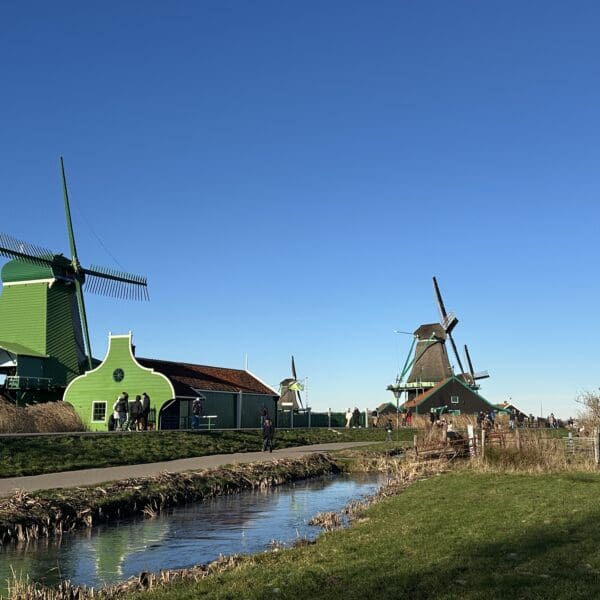
Waterland is the flat, green stretch of polders, dikes and small harbours just north of Amsterdam. It is where you find Marken, Monnickendam, Volendam, Edam and Broek in Waterland, villages that lived from fishing and trade on the old Zuiderzee and still look the part.
Each village has its own character. Marken was an island until 1957 and still feels like one. Monnickendam is a small medieval port known for its smokehouses. Volendam is the busy one, with a harbour front full of fish stalls. Broek in Waterland is the quiet one, a village of wooden merchants’ houses that was famous across Europe for being spotless.
Here is what to see in each:
Our advice: Easy full day
Travel time from Amsterdam: 30 minutes each way.
Marken, Volendam and Broek in Waterland are close enough that your day is spent in the villages, not on the road. Many guests add the windmills of Zaanse Schans to the same day.
Until 1957 Marken was an island in the Zuiderzee. Today a dike connects it to the mainland, but the village still keeps to itself. The wooden houses, painted green and white, stand on raised mounds or on stilts, built that way to stay dry when the sea came in.
The Marker Museum tells the story of the island’s fishing families and their daily life, and in one of the workshops you can watch clogs being made. Some older residents still wear traditional dress on special occasions.
Walk out to the lighthouse at the tip of the peninsula, known locally as Het Paard van Marken (the Horse of Marken), for the view across the water. The Volendam Marken Express ferry links Marken and Volendam in about 30 minutes, which makes it easy to combine the two.
Monnickendam was an important port in the Middle Ages, and its name comes from the monks who built a dam here. The centre is small and well kept, with 17th-century gabled houses along the canals and the large Grote Kerk of St Nicholas, known for its organ.
The harbour is still busy with small boats and yachts, and it is the best place in the village for a coffee by the water. Monnickendam is also known for its smoked fish. Eel and herring are still smoked here in the traditional way, and on some days you can smell it as you walk along the harbour.
For the history of the area, visit the Waterlandsmuseum De Speeltoren, in the old bell tower in the centre, which covers local life, trade and the constant fight against the water.
Volendam is the liveliest of the Waterland villages. Life centres on the harbour and the dike, lined with cafés and stalls selling smoked eel and kibbeling, battered pieces of white fish. Behind the dike is the old part of the village, a maze of narrow alleys and small wooden houses.
The Volendams Museum covers the village’s fishing past, its costumes and daily life, and in several studios you can have your photo taken in traditional Volendam dress. The village is also known across the Netherlands for its music: so many popular Dutch singers and bands came from here that their style has its own name, Palingsound, or eel sound.
In the 17th and 18th centuries Broek in Waterland was where wealthy Amsterdam merchants and sea captains built their country homes. Their wooden houses, many painted in soft greys, blues and greens, still line the water, most of them built before 1850.
The village was famous for being clean. Travellers from abroad wrote about it, and one French visitor called it the temple of Dutch cleanliness. The Church of St Nicholas was burned during the Eighty Years’ War in 1573 and rebuilt from 1628. Inside is an ebony pulpit from 1685, and ceiling paintings that were rediscovered under layers of paint in 1989.
There are no sights to tick off here, and that is the point. Walk the lanes along the water, or cycle out into the polder.
Yes. The villages are close to Amsterdam and to each other, and seeing all four in one day is realistic if the transport is planned well, for example on a private tour with a driver.
Public transport is possible but means several buses and careful timing. Many visitors choose a guided countryside bike tour or a private driver instead. The Volendam Marken Express ferry, about 30 minutes, is a good way to get between Volendam and Marken.
Most visitors spend 45 to 90 minutes per village. The exact time depends on whether you plan to walk, eat lunch, visit a museum, or simply explore.
Mostly, yes. Some streets have uneven cobbles, narrow paths or small bridges. On a private tour the car can get close to each stop and the route can be adjusted to what suits you.
The villages themselves do not require tickets. Specific attractions, museums, or experiences within them may require advance booking, especially in peak season.
Comfortable walking shoes are essential. The countryside can be windy and cooler than Amsterdam, so layers are recommended even in summer.
Yes. The villages are quiet, flat and easy to walk at a relaxed pace, and a good choice for families and anyone who wants a break from the crowds in Amsterdam.