
Enter your travel dates and see which flowers will be out in the Netherlands during your trip: tulips, daffodils, hyacinths and six more, where to find them, and how long the fields have left before they are cut. Keukenhof and the open bulb fields run on different clocks, so both are covered.
Enter the dates you are in the Netherlands and we will show which flowers will be out while you are here, where to see them, and which tours fit.

Bloom status, checked 3 October 2026: outside tulip season. Dahlias are still flowering in the show gardens until the first night frost, usually in late October. Snowdrops follow in February and crocuses in early March. From March to May we update this line every week.
Tulip season in the Netherlands runs from roughly mid-March to mid-May. Tulips themselves bloom from early April to the start of May, and the open fields are at their most colourful from mid-April until they are topped, usually around 1 May. The wider flower season runs from mid-March to mid-May, and tulips share it with two others: daffodils lead from mid-March, hyacinths follow in late March, and tulips take over through April. Those three are the season most people travel for, with snowdrops, crocuses, cherry blossom, freesias, roses and dahlias filling in the quieter months either side. Timing shifts a little each year with the weather, and by a few days between regions.
Solid bands are each flower’s typical bloom window in the open fields. The dashed extension on tulips shows how much longer Keukenhof and other show gardens keep blooming after the commercial fields are cut. Dashed vertical lines mark your travel dates. Switch region above and the whole calendar shifts with it.
West-Friesland and the Noordoostpolder run roughly a week behind the Bollenstreek, so their bloom windows are shown seven days later. Every season is a little different, so treat these dates as a well-informed guide rather than a guarantee.
This is the answer for the dates you entered above: which flowers are realistically in bloom during your visit, from the earliest snowdrops to the famous tulip fields and Keukenhof’s show gardens. Change the dates and it updates straight away.
Three regions grow at scale. The Bollenstreek, the bulb belt between Haarlem and Leiden, has the best-known fields and Keukenhof itself at Lisse, roughly forty minutes from Amsterdam by car. West-Friesland, north of Hoorn, is a similar drive and much quieter. The Noordoostpolder in Flevoland has the largest fields in the country, about ninety minutes out, and runs roughly a week behind the Bollenstreek, which makes it a useful fallback if you arrive late in the season. Compare all three in the calendar above, or read our guide to the tulip fields near Amsterdam for routes and travel times.
Tap a region to switch the calendar below.
The season moves a little every year, but not by much. Here is what a typical year looks like month by month, and what to do if your dates fall either side of the peak.
Early March belongs to the crocuses, and the first daffodils open around the middle of the month. Keukenhof opens on 18 March in 2027, planted in sequence so that something is always in flower, which makes the gardens worth it from day one. The open bulb fields are a different story. Tulips are still green in March, and the sea of colour most people picture does not usually arrive until April. If your dates fall in March, plan around Keukenhof, the daffodil fields and the first hyacinths, and treat any early tulips as a bonus.
April is the month. Hyacinths peak through the first half, tulips take over from the middle, and around the second and third weeks all three of the main season flowers can overlap. Mid-April is the single most reliable week to book, which also makes it the busiest, so secure Keukenhof entry and accommodation well ahead. Cherry blossom adds to it in the first days of the month.

How Are Dutch Tulips So Colourful?
Cutting it fine. In the Bollenstreek the commercial fields are usually topped by around 1 May, and in a warm spring earlier still, so the first days of May are already too late for the open colour there. Further north, in West-Friesland and the Noordoostpolder, the fields run about a week behind and can still be worth the drive in the first week of May. Keukenhof keeps flowering to 9 May in 2027 because it is never harvested, so if your dates fall in May, plan around the show gardens first and treat any field colour as a bonus.
February brings snowdrops. From June the freesias and roses start, and dahlias take over from late July until the first night frost, usually late October, across the show gardens around Lisse and Hillegom. It is a quieter, more local season than spring, and far less crowded. Enter your own dates above and the calendar places them against all nine flowers.
You don’t have to leave the city to see tulips in April. During the Tulp Festival, from 1 to 30 April 2027, hundreds of thousands of tulips are planted in tubs and flowerbeds at more than 100 locations across Amsterdam, from the Dam and Museumplein to the Vondelpark, the Hortus Botanicus and the gardens of the Rijksmuseum. It is free, it reaches every district, and it is the easiest way to see tulips if you only have a few hours in the city.
The Bloemencorso Bollenstreek is the big spring parade of the bulb region. Floats covered in hyacinths, tulips and daffodils drive 42 km from Noordwijk to Haarlem on Saturday 17 April 2027, the highlight of a festival week that runs from 14 to 18 April. It passes right through the flower fields, so it is a good day to combine both.
Visiting in January? On Saturday 16 January 2027, National Tulip Day opens the season with a free tulip garden on Museumplein, from 13:00 to 17:00.
For more festivals and events across the Netherlands and Belgium, see our events calendar.
Curious what is happening underground the rest of the year? Every flower here spends most of its life as a dormant bulb before pushing up, blooming and, for commercially grown tulips, being cut back so the bulb can recover for next season. Pick a flower below to follow its full year.
The tulip gets the attention, but it is one of nine flowers that carry the Dutch season from January to the first night frost. Each one below has its own weeks and its own places, and several of them are easier to see, and far quieter, than the April fields.
Bespoke Amsterdam Experiences is rated 4.9 out of 5 from more than 3,000 guest reviews on Google, Tripadvisor, Airbnb and GetYourGuide, verified by Trustindex.
The first flower of the year, out from around 20 January and at its best in the second week of February. Snowdrops are not a bulb field crop on the scale of tulips, so you look for them in woodland and on old estate ground rather than in open fields.
Where to see them: Texel is the place. They grow through the De Dennen woods and the Molenbos at De Cocksdorp, and one grower on the island raises around five million bulbs in long rows, with Snowdrop Days held in late February and early March. On the mainland, the nursery garden at De Boschhoeve in Wolfheze is known for them. Keukenhof does not open until 18 March, so it is too late in the year for snowdrops. Nearer to Amsterdam, Kasteel de Haar at Haarzuilens, west of Utrecht, has snowdrops through the castle grounds and the adjoining Parkbos, which Natuurmonumenten planted up from divided clumps. Our private castles tour takes in De Haar alongside Muiderslot and Naarden.
Crocuses open from the middle of February and hold into late March, overlapping the end of the snowdrops and the start of the daffodils. They are the flower that tells you the Dutch spring has started, and they flower whether or not anyone planted them on purpose.
Where to see them: Park grass and roadside verges rather than farmland. They naturalise across Amsterdam park lawns and along the verges through the Bollenstreek, and the Hortus Botanicus in Amsterdam has early bulbs under glass and out. Worth noticing on a February city break rather than a reason to drive out. If you want the botanical side of the city, our Amsterdam City Highlights private tour can include the Hortus Botanicus.
The first flower you can genuinely call a bulb field, from around 5 March in the Bollenstreek and about a week later in the north, peaking in the last week of March. Whole plots turn yellow and white, and they are still out when the first hyacinths open.
Where to see them: The Bollenstreek plots around Lisse, Hillegom, Noordwijkerhout and Sassenheim, plus the verges between them, which are planted up too. Keukenhof has them from opening day on 18 March, which matters because the open fields can still be thin that early. Our private Keukenhof and flower fields tour runs from opening day, when the daffodils are the main event rather than the warm-up.
A city flower rather than a field one, out from about 18 March and best in the first days of April. It is the one spring flower on this list you can see without leaving Amsterdam, and the window is short, usually little more than a week at full blossom.
Where to see it: The Kersenbloesempark in the Amsterdamse Bos at Amstelveen, with 400 cherry trees given by the Japan Women’s Club in 2000. One thing worth knowing if you are planning a few years out: the trees are struggling in the compacted clay soil and the park is due to be replanted after the 2028 blooming season with 400 trees that are already ten years old, expected to flower from spring 2029. That makes 2027 and 2028 the last two springs for the trees that are there now. There is blossom scattered across the rest of the city as well, including a stand in the Westerpark, so you are rarely far from it in early April. Our Amsterdam City Highlights private tour can work the blossom into the day while it is out.
Out from around 22 March to the third week of April, peaking in the first week of April. Hyacinths are the ones you smell before you see them: a field of them carries for a few hundred metres on a still morning, and they come in blocks of deep blue, pink and white.
Where to see them: The Bollenstreek plots around Lisse and Hillegom hold most of the Dutch crop, and Keukenhof plants them heavily in the first half of its season. In an average year the first week of April is when hyacinths and the last daffodils overlap. Our private Keukenhof and flower fields tour covers the fields and the gardens in the week the two overlap.
Out from about 2 April in the Bollenstreek and 9 April further north, at its best around 20 April in the south and 27 April in the north, and then topped. Growers rotate their plots every year, so the field that was a sea of red last April may be onions this time, which is why there is no single address to give.
Where to see them: In the Bollenstreek, the roads between Lisse, Hillegom, Noordwijkerhout and Sassenheim, with Keukenhof at Lisse, Tulip Experience Amsterdam at Lisse and The Tulip Barn at Hillegom all built for walking among the flowers. In West-Friesland, the fields around Berkhout, Avenhorn and Wognum near Hoorn, which are far quieter. In the Noordoostpolder, the Tulip Festival route, with the Tulip Experience field at Creil and a pick-your-own garden at Marknesse. The fields themselves are private working farmland, so stay on the verge. Our private Keukenhof and flower fields tour takes in both the open fields and the gardens in one day, which is the way to see them before the fields are topped.
The first of the two summer flowers, outdoors from June until about 20 August and best at the start of July. Most Dutch freesias are cut under glass, but the corms are raised outdoors, so there are real fields to find, and the scent is the reason to find them.
Where to see them: The Kop van Noord-Holland, around Callantsoog and among the bulb farms near Breezand and Anna Paulowna. This is a quiet corner with almost no flower tourism, roughly an hour and a quarter north of Amsterdam. It sits in the same corner of North Holland as Alkmaar, so we pair it with our private Alkmaar and Edam cheese cities tour, which catches the Alkmaar cheese market on a Friday morning in season.
The longest season of the nine, from early June to late October with a first flush around 20 June. Dutch cut roses are a glasshouse crop, so there are no rose fields to drive past; for roses you go to a garden that was laid out for them.
Where to see them: The International Rosarium in the Westbroekpark in The Hague, laid out in 1960, where around 20,000 roses flower across roughly 300 beds and an international jury judges new varieties each summer. Closer in, the Rosarium in the Amstelpark in Amsterdam. Late June onwards is the time for both. Our private Delft and The Hague day trip is the straightforward way to see the Westbroekpark rosarium alongside the city itself.
The genuine second flower season, from around 25 July until the first night frost, usually late October, and at its best in the second half of August. Unlike spring tulips, most dahlias in the bulb region grow in show gardens built for visitors rather than in production fields, so they are not cut while you are looking at them.
Where to see them: Keukenhof Castle gardens, with around 100 varieties and free entry, the CNB show garden at De Tulperij with 600 varieties, and I Love Dahlia, FBT Tuinbouw and CS Weijers. De Tulperij and I Love Dahlia both let you pick or cut your own bouquet, and a signposted 35km cycle route links the gardens. Keukenhof Dahlia Days, with its dahlia sculptures, falls in late August. Kasteel de Haar at Haarzuilens plants dahlias as well, which makes it one of the few places on this page worth the drive in both February and late summer, and our private castles tour goes there. Our private windmills and dahlias tour is built around that season.
Whether you are planning around peak tulip season or the quieter dahlia months later in the year, here are private tours built around exactly what is in bloom when you visit. If your dates fall in spring, the private tulips and windmills tour is the one most guests book, eight hours taking in both Keukenhof and Zaanse Schans; the year round flowers and windmills tour works whatever the season.
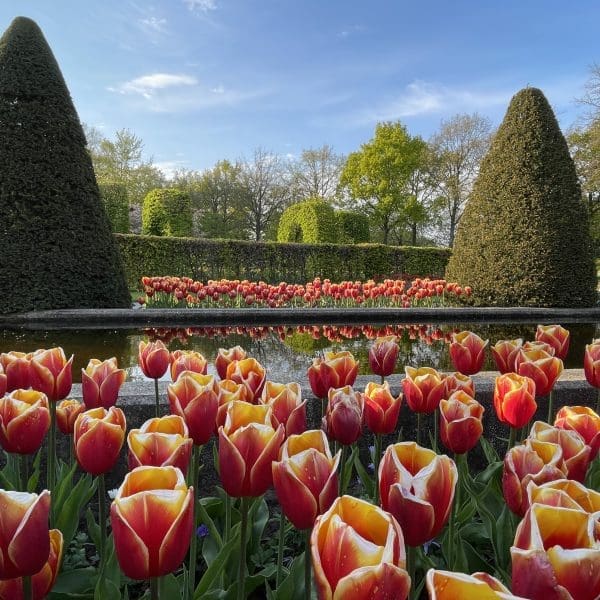
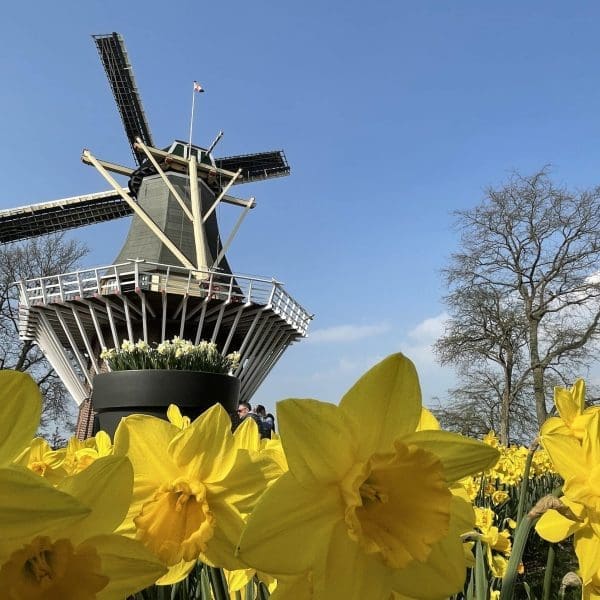
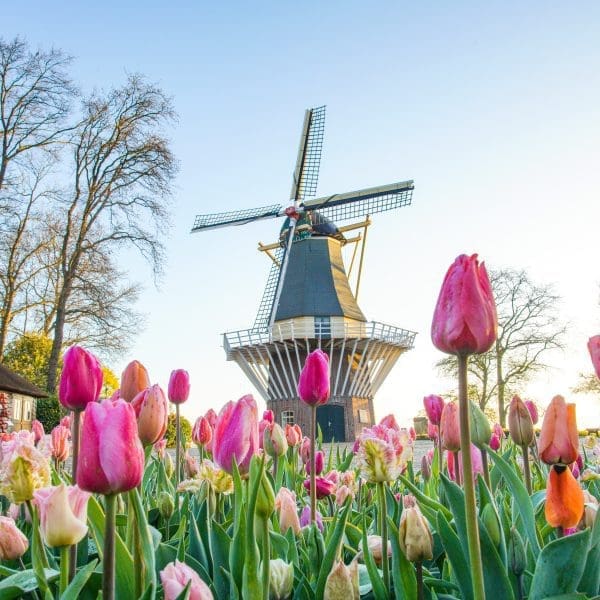
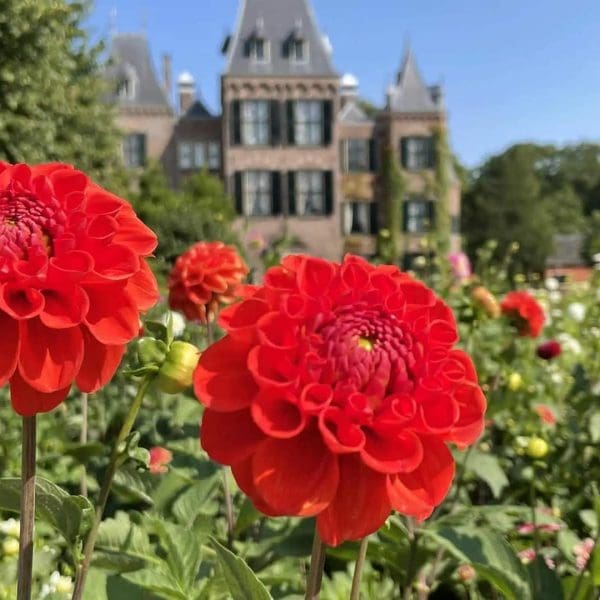

A few things worth knowing before you go, including why some of the most photogenic tulip fields get cut down mid-season, and where it is actually fine to walk in among the flowers.

Most of the Bollenstreek is commercial farmland, grown to sell the bulb rather than the flower. Once a field passes its peak, growers top the heads within about two weeks so the energy goes back into the bulb, which is why a field can be green stubble a week later. Show gardens are not harvested, so they keep flowering.

The fields are private farmland, not a park. Walking in spreads disease between bulbs, costs the grower real money and can mean a fine. A few places exist specifically for walking among the flowers: Tulip Experience Amsterdam, The Tulip Barn, and pick-your-own gardens like De Tulperij and Hanneke’s Pluktuin. Head for one of those instead.

The Bollenstreek runs between Haarlem and Leiden, roughly forty minutes from Amsterdam by car. Keukenhof runs its own shuttle buses through the season, from Leiden, Haarlem and Amsterdam RAI, sold as a combination ticket with entry. The flat lanes between the fields are made for cycling. If you would rather not drive or work to a timetable, our six hour private Keukenhof and flower fields tour goes where the fields are open that week.

Early morning is the quiet hour: soft light, empty verges and room to park. Late afternoon backlights the petals and gives the strongest colour. Midday in April is when the coaches arrive, so that is the stretch to avoid. The rows read best from slightly above, so look for a bridge, a dyke or a raised path.

Tulips reached the Netherlands from the Ottoman Empire in the late 1500s, when the botanist Carolus Clusius planted the first bulbs at Leiden’s Hortus Botanicus. Within decades rare varieties traded for the price of a canal house, and tulip mania collapsed in February 1637. The country now grows around 80% of the world’s tulip bulbs. Read the longer story.

When the tulip fields are cut the region does not close down. Freesias flower outdoors from June, and dahlias take over from late July until the first night frost, usually late October, across show gardens around Lisse and Hillegom, with the Dahlia Festival and Keukenhof Dahlia Days as the highlights. Several gardens let you cut your own bouquet, and our private windmills and dahlias tour is built around that season.
Flowers are only part of what makes a date work. The other trip planning tools cover Anne Frank House ticket releases, festivals and parades, and the museums worth building a day around.
The questions we hear most often about visiting the Netherlands during tulip season, from Keukenhof opening dates to when to buy your own bulbs.
Mid-April is the best single week to see the tulip fields near Amsterdam, with the open fields at their most colourful from about 10 April until they are topped at the end of the month. The Bollenstreek, roughly forty minutes from the city, peaks around 20 April. West-Friesland and the Noordoostpolder run about a week later, which is worth knowing if your dates fall in early May. The exact peak still shifts by a week or so each year with the weather, so check your own dates in the calendar above rather than booking around a fixed date. If you want tulips, hyacinths and the last daffodils all out together, the second and third weeks of April are the overlap.
Yes, by about a week. In the Bollenstreek the tulip fields are normally topped in the last week of April. In West-Friesland and the Noordoostpolder they are normally topped in the first week of May, because the whole season runs later that far north. Growers top the flower roughly ten days to two weeks after peak bloom so the energy goes back into the bulb, which is what they are selling, so a cold spring pushes the cut later and a warm one brings it forward. Only tulips are cut on this scale. Keukenhof and the other show gardens are never harvested and keep flowering until 9 May 2027.
March is daffodils and hyacinths, April is tulips at their peak, and May is the tail end of the season. In more detail: daffodils open from around 5 March in the Bollenstreek and about a week later further north, hyacinths follow from roughly 22 March and are the ones you smell before you see them, and tulips are mostly still green leaf through March, with only the earliest varieties showing colour in the final days. April is the fullest month of the Dutch flower year, when tulips, hyacinths, the last daffodils and cherry blossom can all be out at once; tulips peak around 20 April in the Bollenstreek and 27 April further north, which makes the second and third weeks of April the overlap most visitors are hoping for. Early May still has tulips in West-Friesland and the Noordoostpolder, where the fields are normally topped in the first week, and Keukenhof stays in flower until 9 May 2027, but after the second week of May the bulb season is finished. Keukenhof opens on 18 March 2027 and has colour from opening day even when the fields outside are still thin.
The bloom status line at the top of this page answers that, and it is checked every week through the season. The underlying pattern is reliable: daffodils lead from mid-March, hyacinths from late March, tulips take over from mid-April, and most commercial fields are already cut by about 1 May, a few days later in the north. For your own dates rather than today, enter them in the calendar above and it will list every flower that should be out while you are here.
Keukenhof is open from 18 March to 9 May 2027, daily from 08:00 to 19:00 with last entry at 18:15, and it has something in flower across the whole eight weeks. Its roughly 7 million bulbs are planted in sequence rather than all at once, so there is colour from opening day to closing day, and the second and third weeks of April are usually the most colourful of all, when tulips, hyacinths and daffodils overlap. The season lands in roughly the same window every year, give or take a few days. Tickets are timed entry and the April weekends do sell out, so book online rather than turning up on the day. Our private Keukenhof tour includes entry, so your date is held even once public tickets have gone, and we cover the gardens themselves in our guide to Keukenhof.
For most first-time visitors, yes, with one caveat: it is a garden, not a field. Keukenhof is a curated 32-hectare display garden with around 7 million bulbs across 800 tulip varieties, planted in sequence so something is always in flower across its eight-week season, which makes it the only place that guarantees colour whenever you come. The open fields nearby are a different thing: working farmland growing bulbs to sell, colourful for a shorter window and then cut. If the picture in your head is an open horizon of stripes running towards a windmill, that is the farmland outside rather than the gardens, which is why most visitors do both. That is how our private Keukenhof tour is built: the fields for the big open-sky photograph, Keukenhof for guaranteed flowers and variety even outside peak week. It is genuinely busy on April weekends, so go early on a weekday if you can. There is more on the gardens and the surrounding villages on our Keukenhof region page.
Three regions grow at scale. The Bollenstreek, the bulb belt between Haarlem and Leiden, has the best-known fields and Keukenhof itself at Lisse, roughly forty minutes from Amsterdam by car. West-Friesland, north of Hoorn, is a similar drive and much quieter. The Noordoostpolder in Flevoland has the largest fields in the country, about ninety minutes out, and runs about a week behind the Bollenstreek. There is no single fixed field to visit, because growers rotate their plots every year, so what was a sea of red last April may be onions this time. Our guide to the tulip fields near Amsterdam goes region by region with travel times.
No, they are private working farmland rather than a park. Walking in can spread disease between bulbs and cause real financial loss for the grower, which is why some fields are fenced. A handful of places are built for walking among the flowers instead: Tulip Experience Amsterdam, The Tulip Barn, and pick-your-own gardens like De Tulperij or Hanneke’s Pluktuin.
Snowdrops are at their best around the second week of February, and Texel is the place to go for them. They grow through the De Dennen woods and the Molenbos at De Cocksdorp, one grower on the island raises around five million bulbs in long rows, and Snowdrop Days are held in late February and early March. On the mainland, the nursery garden at De Boschhoeve in Wolfheze is known for them. Crocuses follow from mid-February into late March, but they are not a field crop you would travel for: they naturalise in park grass across Amsterdam and along the verges through the Bollenstreek. Keukenhof does not open until 18 March, so neither flower can be seen there.
The Kersenbloesempark in the Amsterdamse Bos at Amstelveen is the place, with 400 cherry trees given by the Japan Women’s Club in 2000, usually at their best in the first days of April and out from about 18 March. The window is short, often little more than a week at full blossom. One thing worth knowing if you are planning a few years ahead: the trees are struggling in the compacted clay soil and the park is due to be replanted after the 2028 blooming season with 400 trees that are already ten years old, expected to flower from spring 2029. That makes 2027 and 2028 the last two springs for the trees standing now.
Dahlias are a genuine second flower season, blooming from around late July until the first night frost, usually late October, long after the tulip fields are gone. Unlike spring tulips, most dahlias in the bulb region grow in show gardens built for visitors rather than production fields, so they are not cut while you are looking at them. The main ones are Keukenhof Castle gardens, with around 100 varieties and free entry, the CNB show garden at De Tulperij with 600 varieties, and I Love Dahlia, FBT Tuinbouw and CS Weijers. De Tulperij and I Love Dahlia both let you pick or cut your own bouquet, and a signposted 35km cycle route links the gardens. Keukenhof Dahlia Days, with its dahlia sculptures, falls in late August. Freesias flower outdoors just ahead of them, from June to late August: most Dutch freesias are cut under glass but the corms are raised outdoors, so there are real fields in the Kop van Noord-Holland, around Callantsoog and among the bulb farms near Breezand and Anna Paulowna, worth finding for the scent alone. Our windmills and dahlias tour is built around that season.
Bulbs are harvested in summer and go on sale from the end of September, for planting in October and November before the first frost. Never buy “fresh” bulbs in spring, as those are old stock that will not have had the cold period they need to flower. International travellers should also check their home country’s import rules, since bulbs often need a phytosanitary inspection certificate to cross customs. Keukenhof tickets are timed entry and do sell out on peak weekends in April, so it is worth booking online a few days ahead rather than turning up on the day.
| Flower | Bollenstreek 40 minutes from Amsterdam | West-Friesland 45 minutes from Amsterdam | Noordoostpolder 90 minutes from Amsterdam |
|---|---|---|---|
| Snowdrop Sneeuwklokje | 20 January to 10 Marchbest around 10 February | 27 January to 17 Marchbest around 17 February | 27 January to 17 Marchbest around 17 February |
| Crocus Krokus | 10 February to 25 Marchbest around 1 March | 17 February to 1 Aprilbest around 8 March | 17 February to 1 Aprilbest around 8 March |
| Daffodil Narcis | 5 March to 15 Aprilbest around 25 March | 12 March to 22 Aprilbest around 1 April | 12 March to 22 Aprilbest around 1 April |
| Cherry Blossom Kersenbloesem | 18 March to 12 Aprilbest around 3 April | 18 March to 12 Aprilbest around 3 April | 18 March to 12 Aprilbest around 3 April |
| Hyacinth Hyacint | 22 March to 20 Aprilbest around 5 April | 29 March to 27 Aprilbest around 12 April | 29 March to 27 Aprilbest around 12 April |
| Tulip Tulp | 2 April to 1 Maybest around 20 Aprilfields topped in the last week of April | 9 April to 8 Maybest around 27 Aprilfields topped in the first week of May | 9 April to 8 Maybest around 27 Aprilfields topped in the first week of May |
| Keukenhof show garden, Lisse | 18 March to 9 May 2027best around 20 Aprilnever topped, so it flowers across the whole eight weeks | ||
| Freesia Fresia | 1 June to 20 Augustbest around 1 July | 1 June to 20 Augustbest around 1 July | 1 June to 20 Augustbest around 1 July |
| Rose Roos | 5 June to 25 Octoberbest around 20 June | 5 June to 25 Octoberbest around 20 June | 5 June to 25 Octoberbest around 20 June |
| Dahlia Dahlia | 25 July to 31 Octoberbest around 20 August | 25 July to 31 Octoberbest around 20 August | 25 July to 31 Octoberbest around 20 August |
Read these as a well-informed guide rather than a guarantee: the whole season moves by up to a week either way with the winter and spring weather. West-Friesland and the Noordoostpolder run about seven days behind the Bollenstreek, which is why their columns are shifted.
Topping applies to tulips only. The other eight flowers in the table are either left to finish on their own or, in the show gardens, never harvested at all.
Bollenstreek, between Haarlem and Leiden. The tulip fields here are normally topped in the last week of April. That is the earliest of the three regions, so if your dates fall in the first days of May this is the area most likely to have been cut already.
West-Friesland, north of Hoorn. The tulip fields here are normally topped in the first week of May, about a week later than the Bollenstreek, because the whole season runs later this far north.
Noordoostpolder, in Flevoland. The tulip fields here are also normally topped in the first week of May, which makes the polder the best fallback if you arrive at the very end of the season.
All three weeks move with the weather. Growers top the flower roughly ten days to two weeks after peak bloom, once the bulb has had what it needs, so a cold spring pushes the cut later and a warm one brings it forward. Keukenhof and the other show gardens are never harvested and keep flowering until 9 May 2027.