Inspiration for this post came from these two articles Six canal cities to visit instead of Amsterdam and Venice, 28 July 2026, and The Hague as a coolcation, 5 August 2026.
In the space of nine days this summer, The New York Times sent American travellers to two Dutch cities, and neither of them was Amsterdam.
First, Haarlem, which was crowned the best canal city in Europe to visit instead of Amsterdam or Venice. Then The Hague, which was held up as the perfect “coolcation” as Paris and Madrid melt in temperatures above 38 degrees.
As we have private tours that visit both of these cities, we read the two articles with interest. In this blog, we look at what the articles got right, the parts they missed, and what a day in either city actually feels like.
The Times called Haarlem a “miniature version” of Amsterdam. Canals, 17th-century houses, museums full of Dutch masters, and most importantly, no crowds. It is an accurate description, and the twenty-minute train ride from Amsterdam Centraal is a detail that makes it easy: you are not spending a day of your holiday travelling somewhere; you are hopping on a train and arriving before your coffee gets cold.
What greets you is a medieval city centre wrapped around the Grote Markt, with the imposing St Bavo church on one side and terraces on the other. The organ inside the church was played by a ten-year-old Mozart, yet nobody queues to see it.
The real treasure is behind the main streets. Haarlem has hofjes, tiny almshouse courtyards hidden behind plain wooden doors, most of them still lived in by people who would rather you passed through quietly. There are more than twenty of these courtyards. You will walk past a dozen without ever knowing, as nothing on the street tells you they are there.

Haarlem also has art. The Frans Hals Museum holds the largest collection of his work anywhere in the world. Standing in front of his group portraits is the moment the Dutch Golden Age stops being a historical footnote and turns into a room full of people who look like they are about to say something to you. The museum is like a 17th-century Instagram, filled with ‘selfies’ of important people from the age. It is a fraction of the size of the Rijksmuseum, but far less crowded.
A few streets away is the Corrie ten Boom House, where a watchmaker and his daughters hid Jewish neighbours behind a false wall in an upstairs bedroom. The hiding place is still there; it holds six people, and you can climb inside. Tickets are very limited and are usually booked up months ahead. If a visit to the house is important to you, please give us as much notice as possible so we can arrange it for you.
One thing to note. Haarlem on a Saturday is not a secret. The market fills the Grote Markt, the terraces fill up behind it, and you will share the place with a lot of people. Whilst the crowds are nothing like the Damrak or centre of Amsterdam, do not turn up expecting an empty film set. The museums are also closed on a Monday, so if art is your thing, plan to visit on a different day to avoid disappointment.
We have many more suggestions in our guide of things to do in Haarlem, or let us plan your trip in our private Haarlem tour. It is five hours, door-to-door from your hotel to Haarlem, and your guide knows where to find the hofjes and other hidden spots.

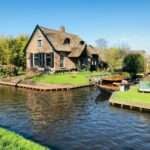
Haarlem has many beautiful canals and gabled houses that are similar to Amsterdam. What it does not have is the crowds on the bridges.
The second article is really about the climate. Southern Europe in August is no longer fun due to the heat, and the cool northern coast is quietly rising in popularity. The Times made the case for The Hague on these grounds: sea air, cobbles, and a beach you can safely swim from.
The day plans itself. Start by catching a tram to head west to the beach. After a twenty-minute journey, you’ll feel like you are in another world. Scheveningen has a real North Sea beach with a pier, a Ferris wheel and rows of pavilions where you can eat with your feet in the sand. Very few people outside of the Netherlands know that the home of international justice has a beach resort next door.
The article mentions that there is a catch. A guide points at a scorched flowerbed near the Spinoza statue in the article and says he does not remember the grass being yellow when he was a child. The Netherlands may be cooler than Spain in August, but the mercury is rising here too.

The Binnenhof: parliament has met on this spot since the thirteenth century.
After a relaxing morning at the beach, head back into the city centre for a serious culture hit. Mauritshuis, a former palace turned into a gallery, is so compact you can see it all in ninety minutes. This is where Girl with a Pearl Earring hangs at eye level in a room the size of a large living room. Everyone says she is smaller than you expect, just like the Mona Lisa, but without the crowds.
A short walk and you reach the Binnenhof, sitting on a lake with swans on it. This is the oldest parliament building still in use on earth. Escher has a whole museum in a former royal residence nearby, complete with a staircase that plays tricks on you. Just up the road, you can also find the Peace Palace.
Discover more things to do in The Hague in our guide.
Girl with a Pearl Earring will not be on display in the gallery between 15 August and 4 October 2026
If you are going to The Hague, add a visit to Delft on the same day. It is fifteen minutes down the road and is where Vermeer was born, worked and buried, all within a few hundred metres. If you stand on the right spot by the water and you are looking at the landscape he painted in View of Delft, with a modern twist, of course.
This city is also where Royal Delft Blue pottery is still made and painted by hand. You may think watching someone place cobalt onto raw clay, knowing it will come out of the kiln that famous blue, sounds like a tourist trap, but it simply is not. The Dutch royal family is buried in the Nieuwe Kerk on the market square, and the old city centre has canals, a surviving city gate, and a windmill, which surprises people who assume windmills only happen out in the countryside in the fields.

Delft during Christmas time with the city hall in the background
Our private Delft and The Hague tour covers both cities in a day, with a visit to Mauritshuis timed so that you walk in rather than queue.
Ghent came a close second on the top canal-cities list, and it certainly deserves the place. The centre is almost entirely car-free, which gives the city a completely different vibe. No vans reversing into your photograph, no traffic lights, just cobbles, water and a whole lot of bicycles. The formidable Gravensteen castle with its moat sits in the middle of city rather than on a hill outside it.
It is a longer trip than Haarlem, as it is roughly two and a half hours driving each way, so it needs planning rather than improvising. If you are tempted, we have a private Ghent walking tour and a guide to Ghent.
Haarlem is the easiest one. It’s just twenty minutes by train, with several trains an hour. The city works well by itself as a half-day if time is short. It also combines neatly with the beach at Zandvoort, or in spring with the flower fields around Lisse and Keukenhof.
The Hague and Delft are roughly fifty minutes south of Amsterdam and together, make a delightful full day. Due to its distance from Amsterdam, Ghent is a full day tour on its own.
If you have a week in Amsterdam and wish to visit two of these cities without the logistics, a pairing that works well is Haarlem as a half day early in the week, then a full day trip to The Hague and Delft later in the week. We are happy to build an itinerary for you whichever way, or combine all three into a longer day.

Scheveningen, just twenty minutes from Mauritshuis but a different world.
Haarlem. In a July 2026 article on European canal cities to visit instead of Amsterdam and Venice, The New York Times placed Haarlem first, describing it as a miniature version of Amsterdam with canals, 17th-century houses and Dutch master paintings, but without the crowds. Ghent came second on the same list.
Yes, noticeably. Haarlem has a fraction of the visitor numbers and you will not queue for anything the way you do in central Amsterdam. It is not deserted, though: Saturday on the Grote Markt is lively, and the market and terraces fill up. Weekday mornings are the quietest.
About twenty minutes by direct train from Amsterdam Centraal, or twenty-five minutes by car. It is close enough to do as a half day, which is why it works so well if you only have a few days in the Netherlands.
A coolcation is a summer holiday chosen for its milder climate rather than its heat. In August 2026 The New York Times pointed American travellers towards The Hague on exactly that basis: North Sea air, Vermeer at the Mauritshuis, and a swimmable beach at Scheveningen, while Paris and Madrid pushed towards 40°C.
Comfortably, and it is the way we usually do it. The two are fifteen minutes apart, so a full day gives you the Mauritshuis, the Binnenhof and the Peace Palace in The Hague, plus Delft’s old centre, the Nieuwe Kerk and Royal Delft. Add Scheveningen beach if the weather cooperates.
At the Mauritshuis in The Hague, about fifty minutes from Amsterdam. It hangs alongside Rembrandt’s The Anatomy Lesson and a compact collection of Dutch Golden Age work. The museum is small enough to see properly in ninety minutes, which is part of its appeal.
All three are perfectly walkable on your own. What a guide adds is access and context: the Haarlem hofjes are behind unmarked doors, the story of the Ghent Altarpiece takes a while to tell properly, and someone else handling the driving and the tickets turns a logistics day into a relaxed one.
The private Haarlem tour starts at €790 for the group and runs five hours. The Delft and The Hague tour starts at €1,150 for a full day. Our Belgian tours, including Ghent and Bruges, are run with a partner operator and are quoted on request, so get in touch and we will come back with a price for your dates. All prices are per group rather than per person and include the guide, transport and entrance tickets.