Almost everyone who comes to Amsterdam has the Rijksmuseum on their list, and a tour with us usually takes you inside to stand in front of Rembrandt’s Night Watch and the great Dutch masters. What far fewer visitors realise is that there is plenty to discover before you even buy a ticket.
The building itself is a work of art, while the gardens surrounding it contain sculpture, architectural fragments, fountains and details that are easy to walk straight past. Together, they make an enjoyable way to spend an extra hour around Museumplein, whether you are visiting the museum itself or simply passing through this part of Amsterdam.
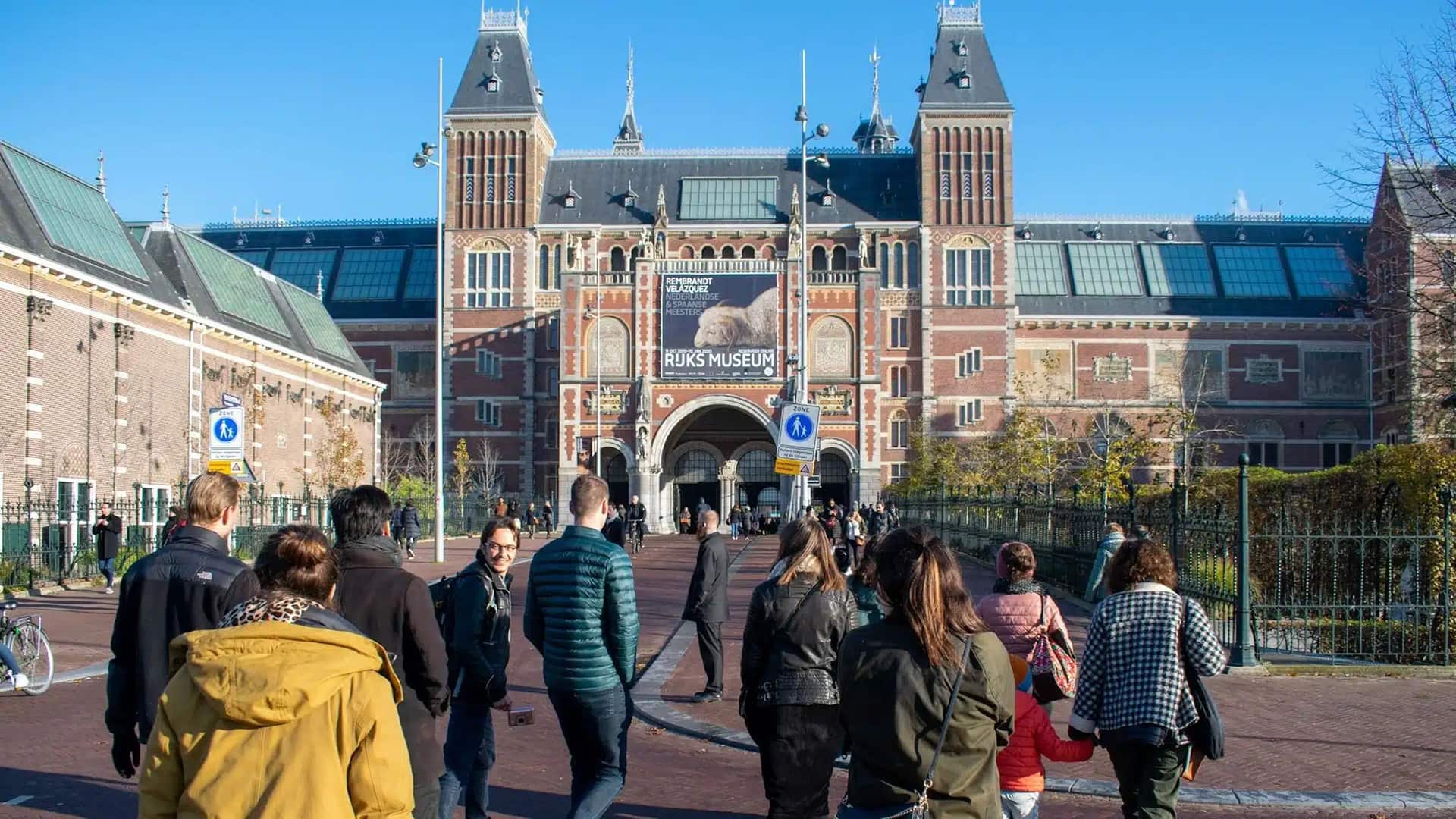
When Pierre Cuypers designed the Rijksmuseum in the late nineteenth century, he created something closer to a cathedral than a conventional museum. Cuypers had made his name designing churches, and that influence can be seen throughout the building, from its towers and vaulted spaces to the stained glass, sculpture, and richly decorated brick and stone.
Interestingly, the building became even more Gothic as Cuypers developed his plans. After his original design had been approved, he reduced some of its Renaissance elements and strengthened its Gothic character. His Catholic background and enthusiasm for medieval architecture were increasingly evident in the finished museum, which did not please everyone at the time. King Willem III famously stayed away from its opening in 1885.
Before any of this could rise above ground, however, there was the very Amsterdam problem of what lay beneath it. The enormous museum had to be supported on around 8,000 piles driven into the city’s soft ground. It is an extraordinary amount of unseen engineering beneath a building already full of things to look at.
Walk through the middle of the Rijksmuseum
One of the great pleasures of the Rijksmuseum is that you can pass straight through the heart of the building without a museum ticket. The public passage beneath it was part of the original design and was actually a requirement of the architectural competition. The museum was intended to act almost like a gateway, connecting the old city with the new neighbourhoods developing to the south.
The passage remains open to pedestrians and cyclists today. Its vaulted ceiling also provides wonderful acoustics, which is why you will often find musicians performing beneath the museum as people cycle and walk past.
But don’t hurry through. Some of the most interesting details are above your head or tucked into the corners.


Read the walls. Look closely at the façades and you begin to realise that the building itself is telling a story. Cuypers covered it with sculpture, reliefs, coats of arms, decorative tiles and references to Dutch art and history. Different parts of the exterior have their own themes, so it is worth walking around rather than seeing only the familiar Museumplein façade.
Find the architect. Cuypers even included himself in the decoration. Following the tradition of medieval master builders who sometimes placed their own likeness on the buildings they created, he left a small self-portrait on the exterior of the Rijksmuseum. It is an appropriate signature on a building where almost nothing seems to have been included by accident.
Look for the Windhoofd. High above the clock is a small golden Windhoofd, literally a ‘wind head’. The figure faces north and blows out his cheeks as if sending a gust of wind across the roof. This type of imagery has its origins in classical representations of the winds, which were often depicted as human faces blowing air. It is another small detail high on the building that is easily missed unless you know to look up.
Find the drainpipe biters. At each of the four corners of the central passage, look closely at the rainwater pipes. Clinging to each one is a small carved animal with its mouth wrapped around the pipe. They appear to be dogs or perhaps stylised lions, but remarkably little seems to have been documented about them. There are four in total, and they are very easy to miss even if you have walked through the Rijksmuseum passage many times. We have yet to find a definitive explanation of what Cuypers intended them to represent.
They are a good reminder that not every detail of a building as richly decorated as the Rijksmuseum comes with a convenient label or explanation. Sometimes the pleasure is simply in noticing it.
Cuypers did not stop with the building. He also designed the surrounding gardens and intended them to demonstrate different styles of historic garden design. They remain free to enter, giving you the unusual opportunity to explore part of the Rijksmuseum without going through the museum doors.
An open-air museum of Dutch history. The gardens contain fountains, clipped hedges, seasonal planting and sculpture, but they were also conceived as a kind of open-air museum of Dutch architecture. Cuypers collected fragments from historic buildings threatened with demolition and incorporated them into the grounds. Among them are the Bergpoort from Deventer and arches from the Kleine Kerk in Edam.
There is also a living survivor from the museum’s earliest days. The large Caucasian wingnut tree in the garden has stood here since the Rijksmuseum’s beginnings on this site. While exhibitions, buildings and even the surrounding city have changed around it, the tree has remained part of the garden for well over a century.
Changing art among the flowers. The lawns double as one of Amsterdam’s finest open-air sculpture spaces, with a changing exhibition each year that has shown work by some of the most celebrated names in modern and contemporary art. Set against clipped hedges and seasonal beds, the pieces feel completely different to art seen indoors.

The Fragmentengebouw: a building made from rescued pieces
One of the most unusual parts of the Rijksmuseum complex takes Cuypers’ interest in preserving old architecture even further. The Fragmentengebouw, or Fragments Building, was constructed between 1890 and 1897 using surviving pieces from historic buildings that had been demolished or altered.
Rather than displaying these fragments simply as museum objects, Cuypers incorporated them into a new building. Among them are parts of the former stable buildings of the Nassau Palace in Breda, dating from around 1620, alongside architectural elements rescued from elsewhere in the Netherlands.
The Fragmentengebouw later became part of what is now the Rijksmuseum’s Philips Wing. It is an intriguing example of Cuypers’ determination to preserve pieces of Dutch architectural history that might otherwise have disappeared completely.
The formal gardens are a pleasure in their own right. Depending on the season, there are bulbs and tulips in spring, roses in summer and carefully maintained beds and hedges throughout the year. Fountains and water features break up the gardens, while a small greenhouse tucked among the greenery adds to the feeling that this is more than simply landscaping around a museum.
The gardens have also become an outdoor setting for sculpture, with temporary exhibitions bringing work by major modern and contemporary artists into the landscape. Sculpture feels very different when encountered among trees, flowers and historic architecture rather than inside a gallery.

Walk around the whole museum, for free. Perhaps the nicest thing is simply to wander. Walk around the building, look back at the towers from different angles, and pay attention to the fragments, carvings, and architectural details along the way. Museumplein can be extremely busy, yet there are corners of the Rijksmuseum gardens that feel surprisingly removed from the crowds and noise.
Bring a coffee or a book, find a bench, and stay for a while. You do not need a museum ticket to enjoy this part of the Rijksmuseum.
There is, of course, much more waiting inside. A visit to the Rijksmuseum brings you face to face with Rembrandt, Vermeer and other great artists of the Dutch Golden Age, alongside centuries of Dutch history, decorative art and craftsmanship. Our private Rijksmuseum tour explores the collection and the stories behind it, while our Amsterdam City Highlights walk can take in the Museum Quarter and the surroundings of the Rijksmuseum.
But even if you do not have time to go inside, don’t simply walk past. Cuypers designed far more than a container for the Netherlands’ art collection. The building, gardens, sculpture and rescued fragments are part of the Rijksmuseum’s story too, and much of it can be discovered without spending anything at all.
If Amsterdam is the start or end of a river cruise, this is one of the easiest and most rewarding ways to spend some of your extra time in the city.
Yes. The public passage runs directly through the centre of the building and is open to pedestrians and cyclists without a museum ticket. It is the only national museum in the Netherlands you can cycle straight through.
Yes. The gardens surrounding the Rijksmuseum are free to enter and contain sculpture, fountains, seasonal planting, and historic architectural fragments. You do not need a museum ticket to enjoy them.
The Rijksmuseum is open daily, generally from 9am to 5pm, and the gardens keep broadly similar daytime hours. Entry to the gardens is free. Early morning and late afternoon are the quietest times, with the best light on the facade.
The cathedral-like building with sculpture and tile tableaux on every side, the public passage through its centre, a statue of the architect Pierre Cuypers, and gardens with fountains, seasonal flowers, a small greenhouse, historic architectural fragments and a changing open-air sculpture exhibition.
You need a ticket to enter the museum galleries, but the Rijksmuseum gardens and the public passage beneath the building can be visited without a museum ticket.
The gardens and the building’s exterior are free and easy to enjoy on your own. To go inside and see the Night Watch and the Gallery of Honour with an expert guide, our private Rijksmuseum tour is the best way to skip the queues and hear the stories behind the art.
The Rijksmuseum was designed by Dutch architect Pierre Cuypers and opened in 1885. His background in church architecture strongly influenced its Gothic character.