You may not immediately recognise the name Yayoi Kusama, but there is a good chance you will recognise her work. Pumpkins covered in polka dots, rooms reflected endlessly in mirrors, and entire spaces disappearing beneath repeated patterns have made her one of the most recognisable artists in the world.

This autumn, the Stedelijk Museum Amsterdam is looking beyond those familiar images with a major exhibition covering more than 70 years of her work. Opening less than a month after Kusama’s death in August 2026 at the age of 97, what was planned as a major retrospective has also become a tribute to an artist with a surprisingly long connection to Amsterdam and the Netherlands.

Yayoi Kusama was born in Matsumoto, Japan, in 1929 and began making art at an early age. She described experiencing visions from childhood in which patterns seemed to spread across her surroundings. Dots, nets and repetition became ways of translating those experiences into art and remained central to her work throughout her life.
In 1957, she left Japan for the United States, eventually becoming part of New York’s experimental art scene. Paintings developed into sculptures, installations, and provocative public performances. Mirrors allowed patterns and objects to appear to continue forever, while repetition became connected to an idea Kusama called “self-obliteration”, where the individual seems to disappear into something much larger.
Her first mirrored environment appeared in 1965, decades before Infinity Mirror Rooms became social-media sensations. Pumpkins also have deep roots in her work, having fascinated Kusama since childhood.

Less well known is Kusama’s connection with the Netherlands. She exhibited at the Stedelijk Museum in 1962 and again in the important Nul 1965 exhibition, where her Aggregation: One Thousand Boats Show was displayed. She later donated the work to the museum.

During the second half of the 1960s, she returned to the Netherlands regularly, exhibiting and staging happenings in Amsterdam, The Hague, Delft and Schiedam. Some were deliberately provocative. In Schiedam in 1967, for example, she painted polka dots onto the naked bodies of participants, causing considerable controversy at the time.
It is easy to see Kusama today through the brightly coloured pumpkins, fashion collaborations and enormously popular Infinity Rooms. Her Dutch years reveal a rather different figure: a radical young artist experimenting with ideas that would eventually make her famous around the world.

Kusama’s long career was not without controversy. Some of her published writing contained offensive and racist descriptions of Black people, passages that received renewed attention as her international profile grew. In 2023, she publicly apologised and said she deeply regretted using hurtful and offensive language.
It is an uncomfortable part of her story and shouldn’t simply be ignored, but nor does it define a career spanning more than seven decades. Kusama’s work explored everything from anxiety and identity to sexuality, war, love and our place within something larger than ourselves.

The Stedelijk exhibition brings together more than 70 years of Kusama’s work, including painting, sculpture, drawing, fashion and installations. It shows how the dots, repeated forms and ideas of infinity now immediately associated with Kusama developed over the course of her career.
At its centre are two Infinity Mirrored Rooms, both from 2025: The Hope of the Polka Dots Buried in Infinity Will Eternally Cover the Universe and Illusion Inside the Heart. Mirrors multiply dots and light until the boundaries of each room seem to disappear.

There is something particularly fitting about this exhibition taking place at the Stedelijk. More than sixty years after Kusama first exhibited here, her Aggregation: One Thousand Boats Show forms part of a much larger account of her career. The experimental young Japanese artist who arrived in Amsterdam’s avant-garde art scene in the 1960s returned to the same museum as one of the most famous artists in the world.
Kusama died in Tokyo on 14 August 2026, just weeks before the exhibition opened. The Stedelijk exhibition now provides an unexpected opportunity to look back across that remarkable career, in a museum that played its own small part in the story.
Yayoi Kusama is at the Stedelijk Museum Amsterdam from 11 September 2026 until 17 January 2027.

Entry to the Kusama exhibition is by timed ticket. Your ticket gives you a start time for the exhibition itself, so it is worth booking ahead on the Stedelijk’s own website, particularly for weekends and school holidays, and arriving a little early so you don’t miss your slot.
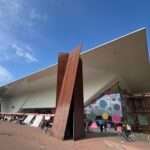
The Stedelijk sits on Museumplein, right next to the Rijksmuseum and the Van Gogh Museum, so the exhibition is easy to combine with more art on the same day, or with a wander through the free Rijksmuseum gardens next door. If you are visiting later in the season, the Amsterdam Light Festival lights up the canals from 26 November 2026 and closes on 17 January 2027, the same day as the exhibition.
To explore the exhibition in more depth, you can also join us for a private guided tour of the Stedelijk Museum, with the tour tailored to focus on Kusama and the stories and ideas behind her work.
The Yayoi Kusama exhibition at the Stedelijk Museum Amsterdam runs from 11 September 2026 until 17 January 2027.
The exhibition is at the Stedelijk Museum on Museumplein, close to the Rijksmuseum and Van Gogh Museum.
Yes, booking ahead is recommended. Entry is by timed ticket with a start time, available from the Stedelijk’s website. Weekends and school holidays are the busiest times to visit.
The exhibition covers more than 70 years of Kusama’s career, including paintings, sculpture, drawings, installations, fashion, performance and her famous use of dots and repetition.
Yes. The exhibition includes two Infinity Mirrored Rooms, both from 2025: The Hope of the Polka Dots Buried in Infinity Will Eternally Cover the Universe and Illusion Inside the Heart.
Kusama spent considerable periods in the Netherlands during the 1960s and was involved with the Dutch avant-garde art scene. She exhibited and staged happenings in Amsterdam and elsewhere in the Netherlands.
Yes. Kusama exhibited at the Stedelijk in 1962 and in the influential Nul 1965 exhibition. The museum also has her Aggregation: One Thousand Boats Show in its collection.
Yayoi Kusama died in Tokyo on 14 August 2026 at the age of 97, shortly before the Stedelijk exhibition opened.
Yes. Our private guided tour of the Stedelijk Museum can be tailored to focus on Kusama, her years in the Netherlands and the ideas behind her work. We plan it around your dates, and short-notice requests are welcome too.