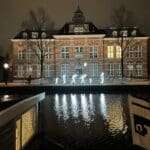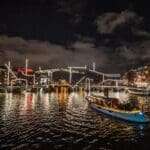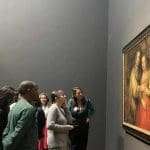
Modern Dutch architecture has one very iconic hero: Hendrik Petrus Berlage. Berlage was a prominent architect that introduced modernism and ‘practical aesthetics’ into Dutch architecture. His distinct simplistic style was focused on the purpose of bringing the community together.
I should be thanking Berlage big time, as my house is designed by him. I really love Berlage’s use of open spaces, as I get to have a really spacious living room. But enough about me and my big house. Let’s find out more about Berlage and his work.
Berlage’s belief was that society had lost its spiritual values that served as the glue of communities. Because of this, he strived to bring these values back by incorporating elements from Classical Greek and Gothic European in his designs. His work is a stylistic mishmash of these two eras for the first part of his career.
When designing the first Amsterdam Commodities Exchange, Berlage was inspired by the Neo-Romanesque brickwork architecture of Henry Hobson Richardson. He combined such elements with structures of iron like those seen in the Castle of the Three Geckos of Dom nech I Montaner.
But after a trip to the U.S. in 1911, Berlage’s architecture had taken a shift towards the organic style and principles of Frank Lloyd Wright. Not only did he propagate this type of architecture in the Netherlands. He also spread Wright’s ideologies through Germany.
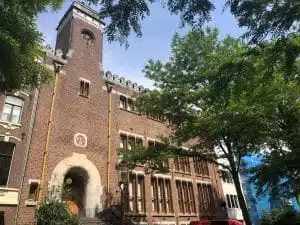
Burcht van Berlage
Probably Berlage’s most significant contribution to Dutch architecture is that he served as the link between the Traditionalists and the Modernists. He inspired the architects of the 1920s, including the Amsterdam School, De Stijl, the Traditionalists the New Objectivists. Without a doubt, he rightfully earned his title as the Father of Modern Architecture in the Netherlands.
Fun Fact: As gratitude for his stellar contribution in Dutch architecture, there is a crater on Moon named after him. For the time being, there is no tour that takes you to the Berlage lunar crater (although that would be pretty cool). Thank god there are some places here on Earth that you can visit.
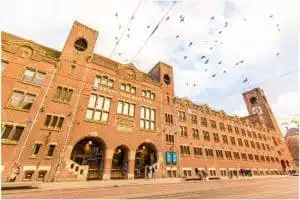
The most famous building designed by Berlage is ‘The Beurs van Berlage’. This building secured his position as a leading figure in Dutch architecture. It was built between 1898 and 1903, and it initially served as a headquarter for the Amsterdam Stock Exchange.
Berlage
However, Berlage was an ardent socialist and believed that the stock exchange would not last for long. Therefore, he decided to take a creative approach. He designed the new stock exchange building in such a way that the building could later be used as a grand community house. Good to know that his idea worked in the long run. Today, the Beurs is no longer the city’s stock exchange. The building is now used as an exhibition and concert-hall.
Berlage viewed the building as a representation of the democratic society: ‘insignificant as an individual, but a power as a mass?’
By affirming his practical designs using Romanesque brickwork, inspired by American architect Henry Hobson Richardson, he created the building with its simple yet striking facade in the centre of the city.
The Beurs was erected on a newly created piece of land. The piece was made by covering the oldest harbour basin located in the centre of Amsterdam.
The architectural aesthetics of Beurs are based on simplicity and soberness. The building stood out in its time for not copying the gothic or renaissance style featured in Amsterdam’s other important city buildings. While many Amsterdammers were not thrilled with it, the structure established its new and unique style. Now it’s one of the most recognizable buildings in the city. Beurs van Berlage was also where the civil ceremony of the wedding of King Willem-Alexander, and Maxima Zorreguieta was held on 2 February 2002.
We can observe that there is only one decoration, the big clock from the high tower. As the Anne Frank & Jewish History Tour walks through the centre of Amsterdam, we will pass this magnificent clock. The tour will also allow people to see the three sculpture figures that surround the building. Each statue features an influential figure in Dutch history.
Beurs van Berlage also has a cafe located on the Beursplein side. A cultural square in the centre of Amsterdam, that you might want to check out.
The inside of the building is just as exquisite as the outside. Apart from the well-preserved interiors, you can see the main hall initially used as a commodity trading floor, and its carefully crafted decorations. Light floods the room through the double glass panes built in the ceiling. Other organic elements, such as glazed bricks, stone, wood, and iron, are aesthetically combined.
In 1999, the Union Internationale des Architectes placed the Beurs van Berlage on the list of the top 1,000 most important buildings of the twentieth century.
Amsterdam’s South Side
Hendrik Petrus Berlage can also be credited for designing the south side of Amsterdam. The Plan Zuid (‘South Plan’) was an urban development plan of Amsterdam South (undertaken by the architect).
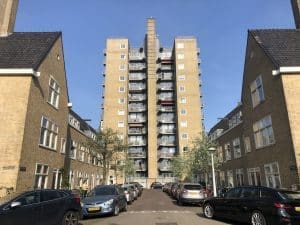
Berlage was in charge of creating the urban layout (1915). Together with the architects of the Amsterdam School, he designed the city’s plan. The plan featured straight narrow streets and long blocks intersected by several broad axes; after it was approved, constructions began in 1917.
Between 1917 and 1925, The New South district was built based on the style of the Amsterdam School. The Stadium District, the Apollo, and the Rivers District are the most notable buildings in this side of Amsterdam; other parts of the city are derived from Plan Zuid.
While the buildings he created will represent great feats in the Dutch architecture, Berlage s work left a lasting impact by introducing a new style to the Amsterdam School and, of course, by giving me a huge living room.
To see Berlage’s work in full context, alongside the architectural layers that define Amsterdam across every era, our private architecture tour of Amsterdam explores the city’s built heritage with a guide who understands what makes each building, street and square so remarkable.
Berlage (1856 to 1934) was the Dutch architect widely regarded as the father of modern architecture in the Netherlands. Born in Amsterdam, he turned away from the historical imitation that dominated nineteenth century Dutch building and argued instead for honest materials, clear structure and buildings that served the community. His work became the bridge between the traditionalists of the 1800s and the modernists of the 1920s, including the Amsterdam School and De Stijl.
The Beurs van Berlage on Damrak, built between 1898 and 1903 as the Amsterdam commodities exchange. Its sober brick facade and single decorative clock tower were a deliberate break from the gothic and renaissance styles of the city’s other landmark buildings, and plenty of Amsterdammers disliked it at first. In 1999 the International Union of Architects placed it on the list of the thousand most important buildings of the twentieth century.
Yes, although it is not a museum and no longer a stock exchange. It works today as an events and conference venue, so public access depends on what is on. Trade fairs, festivals and concerts are open to ticket holders, and the building also houses restaurants and escape rooms that you can visit without an event ticket. It is worth checking the venue’s own calendar before making the trip.
Berlage was a committed socialist who doubted the stock exchange would last. He designed the Beurs so it could later serve as a grand community house, with a vast hall lit through double glass ceiling panels that would work as well for public gatherings as for trading. He was proved right. The exchange moved out long ago, and the building has now spent far more of its life as a public space than as a trading floor.
Beyond the Beurs, his largest mark on the city is Plan Zuid, the 1915 urban design for Amsterdam South. Building began in 1917 and produced the New South, with straight narrow streets and long blocks cut by broad axes, filled in by architects of the Amsterdam School. The Stadium District, the Apollo area and the Rivers District all grew out of his plan, and much of the rest of the city borrows from it.
His other acknowledged masterpiece is the Kunstmuseum in The Hague, completed in 1935, a year after his death, and rated by many critics above the Beurs. It makes a natural centrepiece for a private day in The Hague. There is also a crater on the Moon named after him, which we are not yet able to include in a tour.