The Pulitzer is one of the best addresses in Amsterdam to begin a tour on foot. Twenty five canal houses joined into a single hotel between the Prinsengracht and the Keizersgracht, with the Nine Streets wrapped around the building, the Jordaan one bridge away and the Anne Frank House five minutes up the water. We are a private tour company based here in Amsterdam, and for guests staying at the Pulitzer that address does most of our work for us. Almost every tour we run in the city can start in your lobby, at the hour that suits your morning.

In 1970 Peter Pulitzer, grandson of the newspaper publisher Joseph Pulitzer, bought twelve run-down canal houses on this stretch of the Prinsengracht. He then spent the next thirty years buying their neighbours, on the principle that the house next door only ever comes up for sale once. By the time he had finished there were twenty five of them, seventeenth and eighteenth century, knitted into a single hotel.


That is why the place behaves the way it does. Corridors bend for no obvious reason, floor levels step up and down between one house and the next, and no two rooms are quite the same shape. The 2015 redesign by Jacu Strauss leaned into that rather than smoothing it out, giving each house an imagined former owner with an obsession. That is where the Collector’s Suites come from: a book collector, an art collector, a porcelain collector. It is a conceit, but an honest one, because these houses really were built for merchants who each had a trade and a cargo.


Once a year the water in front of the hotel becomes the most watched canal in the country. The Prinsengrachtconcert, the closing night of the Grachtenfestival, is played from a pontoon moored directly in front of the Pulitzer on a Saturday evening in August. It is free, it is broadcast nationally, and the audience listens from boats and from the bridges. If your stay falls in that week, we will build the day around it.
Guides like starting here because the building explains the city before you have walked anywhere.
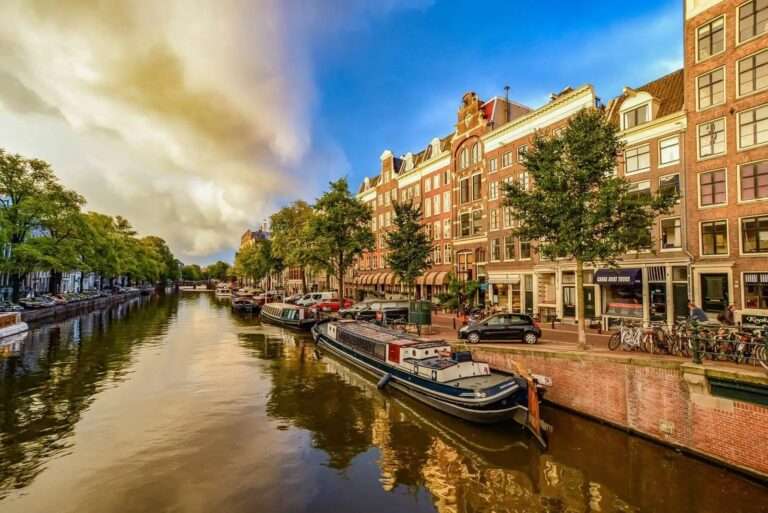
Look up at the facades and almost every one has a beam with a hook sticking out over the street. Amsterdam’s staircases were built steep and narrow to save floor space, so furniture never went up them. It went up the outside on a rope, and many of the houses lean deliberately forward so that a wardrobe on its way to the fourth floor swings clear of the windows below.


The narrowness is a tax story. Householders were charged on the width of their canal frontage, so a merchant bought as little canal as he could live with and built backwards instead: thin at the front, long and deep behind, with a garden at the rear you would never guess at from the street. Our private architecture tour starts from exactly this spot and spends the morning reading the canal belt this way.
Then there is the question of which canal you are on. The Keizersgracht houses in the hotel are the grander ones, because the wealthiest merchants built as close to the old centre as they could afford. The Prinsengracht was the outer ring, cheaper, more workaday, nearer the warehouses. Four hundred years of Dutch social sorting, written into the width of a facade and the height of a gable, and all of it visible from your own front door.
Step out of the Pulitzer and you are in the Negen Straatjes, the Nine Streets. Reestraat, Hartenstraat, Berenstraat, Wolvenstraat, Runstraat, Huidenstraat. Roe deer, hart, bear, wolf, tanning bark, hides.
They are named that way because this was the leather quarter. Tanners and skinners needed water on both sides of a short street, and these nine little connectors between the canals were exactly that. The trade is long gone and the shops that replaced it are some of the best small retail in Europe, but nobody ever changed the names.
Amsterdam is full of this. A street name is often just a receipt for what used to happen there, and once someone points it out you cannot stop reading them.
These are the places our guides work into a morning on foot. The Private Anne Frank and Jewish History Walking Tour and the Private Architecture Tour Amsterdam both take them in, and the six tours further down cover the rest of the city.
Beyond the three above, these are the six we would suggest next from the Pulitzer. City Highlights and Amsterdam in a Day cover the centre on foot from the lobby. Brews and T’Ales crosses the water into the brown cafés of the Jordaan, and the photo tour works the canals around the hotel when the light is best. The Rijksmuseum tour is led by our art historian, and Zaanse Schans is the easiest windmill trip from this side of the city.
 Amsterdam City Highlights Private TourFrom 400 euroView this tour
 Brews and T’Ales, Private Craft Beer TourFrom 500 euroView this tour
 The Ultimate Amsterdam in a Day TourFrom 990 euroView this tour
 Private Rijksmuseum TourFrom 360 euroView this tour
 Private Photo Tour AmsterdamFrom 400 euroView this tour
 Private Zaanse Schans Windmill and Dutch Villages TourFrom 1,100 euroView this tour
See all our private tours from Amsterdam about Private Tours Amsterdam
For anything outside the city we collect you at the Pulitzer with a car and a private guide and bring you back to the same door. The windmills of Zaanse Schans, the tulip fields and Keukenhof in season, Delft and The Hague, Giethoorn, the cheese towns of Alkmaar and Edam. Most run seven to nine hours, and the full range is on our private driving tours page.
The hotel’s position on the western side of the centre helps here. The ring road is quick to reach and you are not crossing town at nine in the morning, which on a Keukenhof day is worth a good half hour of daylight at the other end.
The one practical point is the pick-up. The Prinsengracht is narrow and one way, so we agree a precise spot and a precise time and confirm it with you directly the evening before. Your guide waits in the lobby rather than texting you from a bridge.
Eight minutes from the hotel, at Egelantiersgracht 105 to 141, there is a plain doorway that thousands of people walk past every day. Behind it is the Sint Andrieshofje, an almshouse courtyard founded by the Catholic merchant Jan Oly in the mid 1610s, which makes it one of the oldest in the city. You go down a narrow passage and come out into a garden where the traffic noise simply stops.
These are homes, not a museum, and that is the point. People live in them now. The gate is usually open during the day and visitors are welcome as long as they are quiet and do not photograph the windows. There are half a dozen more of these courtyards within a fifteen minute walk of the Pulitzer, and knowing which doors open is most of what a good guide is for.
A large share of our work comes through advisors and concierge teams, and we try to make it easy to hand over. One point of contact, written confirmations your client can read before they fly, guides who arrive early, and direct contact with the guests themselves the day before so everyone knows exactly where and when to meet. Our travel advisor page has the commission terms and a direct line.
If the concierge would rather hold the booking, they can. Send them our details and we will deal with them directly.
Yes. Every tour we run can begin at the hotel. Walking tours start in the lobby, and for driving tours the car meets you at a confirmed point a very short walk away, because the Prinsengracht is not a street a car can wait on. We confirm the meeting point with you directly the day before.
About five minutes on foot, north along the Prinsengracht on the same side of the canal. Entry is by timed ticket and they go early, which is one reason our Anne Frank and Jewish History tour is built the way it is.
Yes. We collect you at the Pulitzer and bring you back to the same door. Zaanse Schans, Keukenhof in spring, Giethoorn, Delft and The Hague all work comfortably from here. The full range is on our private driving tours page.
It is. Two or three hours through the Nine Streets and the Jordaan is a good way to spend the gap, and the hotel will hold your luggage while you walk. See the full list of Amsterdam tours for the shorter options.
English as standard, and we also have guides in German, French, Spanish, Portuguese and Dutch. Tell us which you would prefer when you enquire.
There is no cut-off, and last minute is genuinely fine. Booking two to four weeks ahead gives you the widest choice of guides, and Keukenhof in April and the Anne Frank tours do fill up, but we arrange tours at short notice all the time. If you are already at the hotel and want something tomorrow, or even later today, just ask. We will usually find a way. Message us through the contact page or call.