Less than an hour from Amsterdam, Delft feels remarkably different from the capital. Its compact historic centre has canals, narrow streets, old merchant houses and church towers, but generally at a much calmer pace.
Delft is best known for Johannes Vermeer and its distinctive blue-and-white pottery, but there is much more behind the familiar images. This was the home of William of Orange, an important city in the formation of the Dutch Republic and later a centre of science and industry. Today, Delft University of Technology continues that connection with innovation.
For anyone wanting to see a traditional Dutch city beyond Amsterdam, Delft is an easy and rewarding place to start.

Delft’s connection with the Dutch royal family goes back to William of Orange, who made his home here during the Dutch Revolt against Spanish rule. He was assassinated in 1584 at the former Sint-Agathaklooster, now Museum Prinsenhof Delft, where the bullet holes associated with his assassination can still be seen.
William was buried in the Nieuwe Kerk on Delft’s Markt, beginning a tradition that continues today. The royal crypt beneath the church is the burial place of members of the House of Orange-Nassau. Despite its name, the Nieuwe Kerk is hardly new. Construction began at the end of the fourteenth century, and its enormous tower has dominated Delft’s skyline for centuries.
On 12 October 1654, a gunpowder store exploded in what became known as the Delft Thunderclap. A large part of the surrounding neighbourhood was destroyed and many people were killed or injured, including Carel Fabritius, a pupil of Rembrandt and one of the most promising painters of his generation.
Johannes Vermeer was also living in Delft at the time but survived. When a replacement gunpowder store was built a few years later, the authorities understandably chose a location safely outside the city walls.
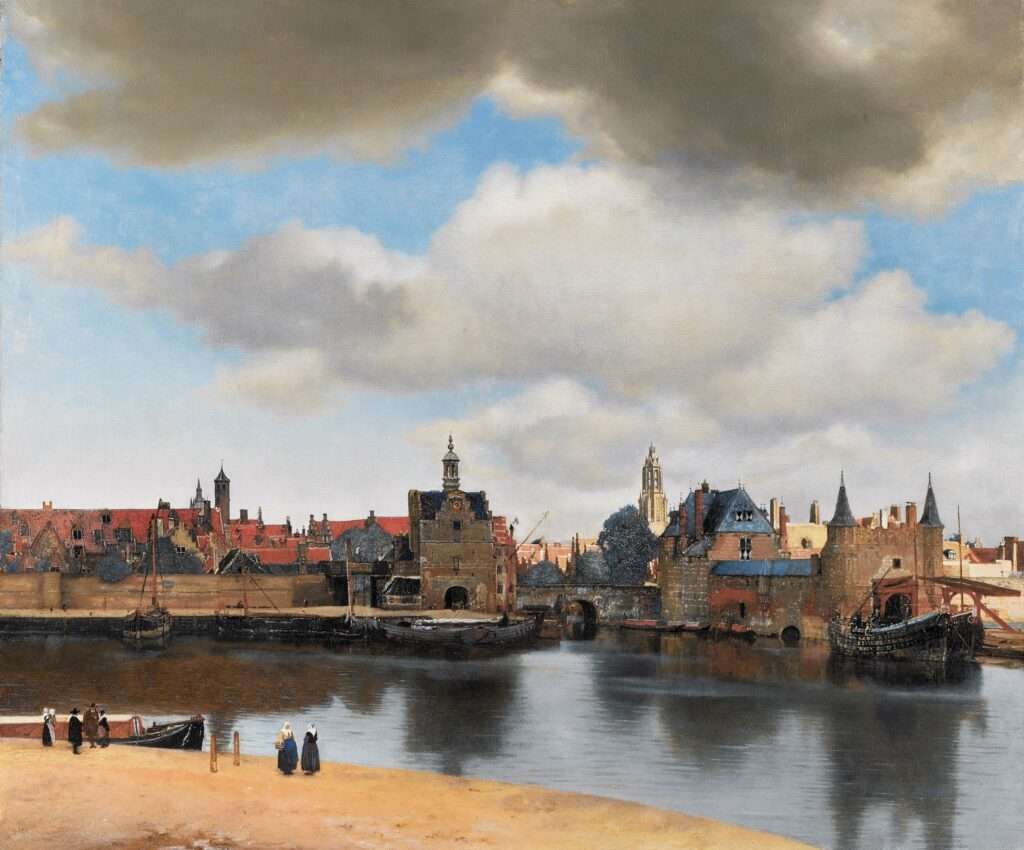
Vermeer was born in Delft in 1632 and spent his entire life here. Although relatively few of his paintings survive, works including Girl with a Pearl Earring, The Milkmaid and View of Delft have made him one of the world’s most celebrated Dutch painters.
There are no original Vermeer paintings in Delft today, but the Vermeer Centrum Delft explores his life, paintings and techniques through reproductions and displays. You can also visit the Oude Kerk where he was buried and Vlamingstraat, where one of the houses has been proposed as a possible location for The Little Street, although its exact location remains debated.
Perhaps the strongest connection is at the Hooikade, close to the viewpoint from which Vermeer painted View of Delft around 1660. The surroundings have changed, but you can still stand close to where Vermeer looked across the city more than 350 years ago.

During the seventeenth century, imported Chinese porcelain became enormously fashionable in the Dutch Republic. Delft potters developed their own tin-glazed earthenware, including the blue-and-white designs that became known around the world as Delftware.
Dozens of pottery factories once operated here. Royal Delft, founded as De Porceleyne Fles in 1653, is the last surviving factory from Delft’s great seventeenth-century pottery industry and still produces Delft Blue today. Its museum and factory allow visitors to see how Delftware is made and how its designs have developed over almost four centuries.

Near the Oude Kerk stands Delft’s enormous Blue Heart, a contemporary sculpture made from blue glass. Nearby, the Oude Kerk has a rather older quirk: its fourteenth-century tower leans noticeably to one side and is known locally as Scheve Jan, or Leaning John. Vermeer and microscope pioneer Antonie van Leeuwenhoek are both buried inside.
Delft also has a working windmill. Molen de Roos still grinds grain in the city centre and survived an unusual episode when Delft’s railway was moved underground. The entire 1,100-tonne windmill was raised by about a metre so that construction could take place beneath it. On the eastern edge of the centre is the Oostpoort, built around 1400 and the only surviving medieval city gate. Its twin towers beside the canal create one of Delft’s most recognisable views.

Close to Delft station, the Constantijn Huygens Gallery brings the city’s story firmly into the present. Created by artist Job Smeets, its walls and ceilings are covered with Delft-blue tiles made by Koninklijke Tichelaar Makkum, filled with references to Delft’s art, science, industry, history and people.
Much of the gallery can be seen through the huge glass windows of Huis van Delft. It is particularly impressive after dark, when the illuminated interior glows through the glass like a cut diamond. It is worth stopping for a closer look as you walk between the station and the historic centre.

Part of Delft’s appeal is its scale. Its canals, stepped façades, brick houses, bridges and narrow streets provide the traditional Dutch setting many visitors are looking for, but in a compact centre that is generally much calmer than Amsterdam. Delft is less than an hour from Amsterdam by train and also combines easily with nearby The Hague, where Vermeer’s *View of Delft and Girl with a Pearl Earring can be seen at the Mauritshuis.
If Delft has tempted you to explore further, you can find more ideas on our Locations page, covering destinations across the Netherlands and Belgium. We also visit Delft on our private Delft & The Hague tour from Amsterdam, combining the city with nearby The Hague and its very different history, architecture and character.
For a relatively small city, Delft packs in a surprising amount: Vermeer and Delft Blue, royal history, a gunpowder disaster, a leaning church, a working windmill and a modern gallery glowing blue beside the railway station. It is a very different experience from Amsterdam, and precisely why it is worth making the short journey.
*Vermeer’s paintings are not currently on display at Mauritshuis
Yes. Delft has a compact historic centre with canals, churches, museums, Delftware, Vermeer connections and several unusual sights, making it an easy day trip from Amsterdam.
Delft is less than an hour from Amsterdam by train, with the historic centre within easy walking distance of Delft’s incredible station.
Delft is particularly famous for Johannes Vermeer, Delft Blue pottery and its connection with William of Orange and the Dutch royal family.
There are no original Vermeer paintings in Delft, but the Vermeer Centrum Delft explores his life and work through reproductions. Several places associated with him can also be visited around the city.
Yes. Royal Delft, founded in 1653, is the last surviving factory from Delft’s seventeenth-century pottery industry and continues to produce Delft Blue today.
Members of the Dutch royal family are traditionally buried in the royal crypt beneath the Nieuwe Kerk in Delft, beginning with William of Orange.
Yes. Delft and The Hague are very close by train, making them easy to combine. The Mauritshuis in The Hague also houses Vermeer’s View of Delft and Girl with a Pearl Earring.